
Introduction
Finding a supplier should be simple.
A buyer knows what they need, searches for capable companies, compares a few options, and starts a conversation.
In reality, supplier discovery rarely works that smoothly.
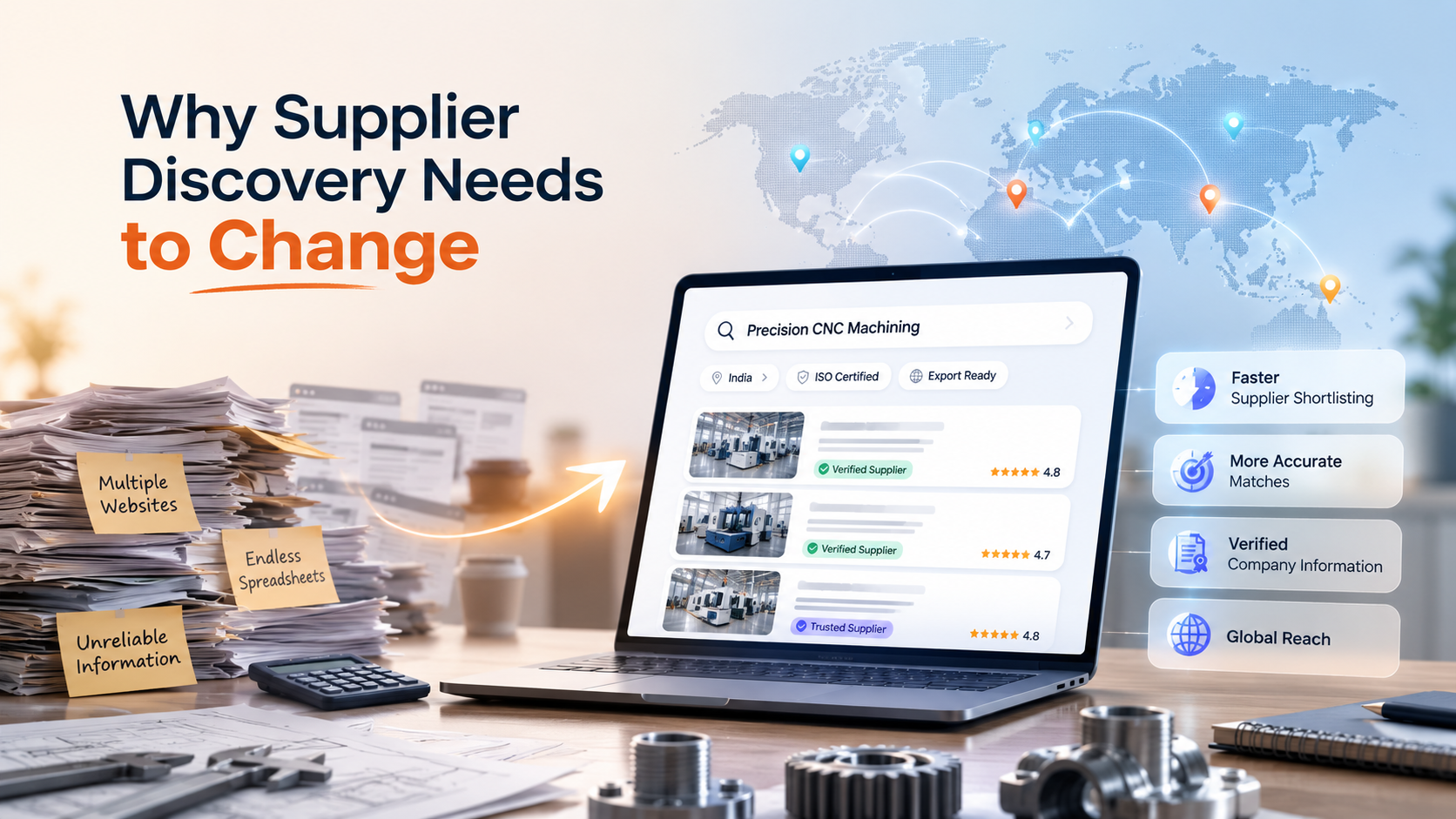
Procurement teams often jump between Google searches, directories, spreadsheets, referrals, trade portals, PDFs, and company websites just to build an initial shortlist.
The problem is not that supplier information does not exist.
The problem is that supplier information is scattered, inconsistent, difficult to compare, and rarely presented in the context of what the buyer actually needs.
That is why supplier discovery needs to change.
🔍 The Traditional Search Model Is Too Manual
Consider a buyer looking for a custom control panel manufacturer.
Typing that phrase into a search engine may return hundreds of results.
But the buyer still needs answers.
Does the company actually manufacture panels?
Can it handle the required PLC brand?
Does it serve the buyer’s industry?
Can it deliver to the required location?
What certifications does it have?
Does it handle custom projects?
A search result provides links.
It does not necessarily provide answers.
This creates a familiar sourcing journey:
Search → Open websites → Read pages → Create spreadsheet → Contact suppliers → Discover many are unsuitable → Start again
The process consumes time before meaningful supplier conversations even begin.
🧩 Supplier Information Is Difficult to Compare
Every supplier presents information differently.
One website may highlight technical capabilities.
Another focuses on industries served.
Another may only have a basic company profile.
Some important information may be buried inside brochures, product pages, certifications, or downloadable PDFs.
The buyer has to manually convert all this unstructured information into something comparable.
Ideally, supplier discovery should answer practical questions immediately:
Buyer Needs to KnowWhat MattersCapabilityCan they actually make it?Industry fitHave they worked in this sector?LocationCan they serve the required region?CapacityCan they handle the project size?TrustAre their credentials credible?Commercial fitMOQ, lead time, payment termsDiscovery should organize suppliers around these questions, not simply present another long directory.
🤖 Search Should Understand the Requirement
Industrial sourcing is often too complex for keyword matching.
A buyer may write:
“We need a manufacturer who can build stainless-steel electrical control panels for a food processing facility, preferably in Maharashtra, with Siemens PLC experience.”
This is not one keyword.
It contains multiple requirements:
📍 Location 🏭 Manufacturing capability ⚙️ Technical expertise 🍽️ Industry context 📦 Product requirement
Modern supplier discovery should understand this context and identify companies that fit the complete requirement.
That is where AI can significantly change the sourcing experience.
Instead of asking buyers to repeatedly apply filters, AI-powered discovery can interpret natural-language requirements and progressively refine recommendations.
✅ Verification Must Become Part of Discovery
Finding a company is only the beginning.
Buyers also need confidence that the information they are seeing is accurate.
A modern supplier ecosystem should clearly distinguish between:
Publicly discovered companies
Claimed supplier profiles
Verified businesses
Trusted or premium suppliers
This creates transparency without excluding smaller companies that may not yet have sophisticated digital profiles.
The objective should not simply be to build the largest supplier database.
It should be to build the most useful and trustworthy sourcing environment.
🚀 Discovery Should Continue Beyond the Search Result
Another major limitation of traditional directories is that their job ends once suppliers are displayed.
But buyers still need to shortlist companies, compare them, send enquiries, request quotations, track conversations, and make decisions.
The future of supplier discovery should therefore look more like:
Describe → Discover → Evaluate → Compare → Engage → Decide
All within one connected sourcing journey.
The Shift: From Supplier Search to Supplier Intelligence
Procurement teams do not need more links.
They need better answers.
The next generation of supplier discovery platforms will increasingly combine structured supplier data, AI-powered matching, verification, contextual recommendations, and sourcing workflows.
The biggest change will be simple but important:
Instead of asking buyers to find suppliers themselves, sourcing platforms will help them understand which suppliers are actually right for the requirement.
That is the difference between supplier search and intelligent supplier discovery.