
Introduction
You know what you need manufactured.
Now comes a surprisingly important question:
Should you find an OEM or work with a custom manufacturer?
The answer depends on whether you're buying an established product, modifying an existing solution, or asking someone to manufacture something specifically for you.
Choosing the wrong model can lead to unnecessary development costs, limited customization, longer lead times, or a supplier that simply isn't structured for your requirement.
Here's how to decide.
🏭 First: What's the Practical Difference?
The terminology can vary between industries, but from a sourcing perspective, think about the distinction this way:
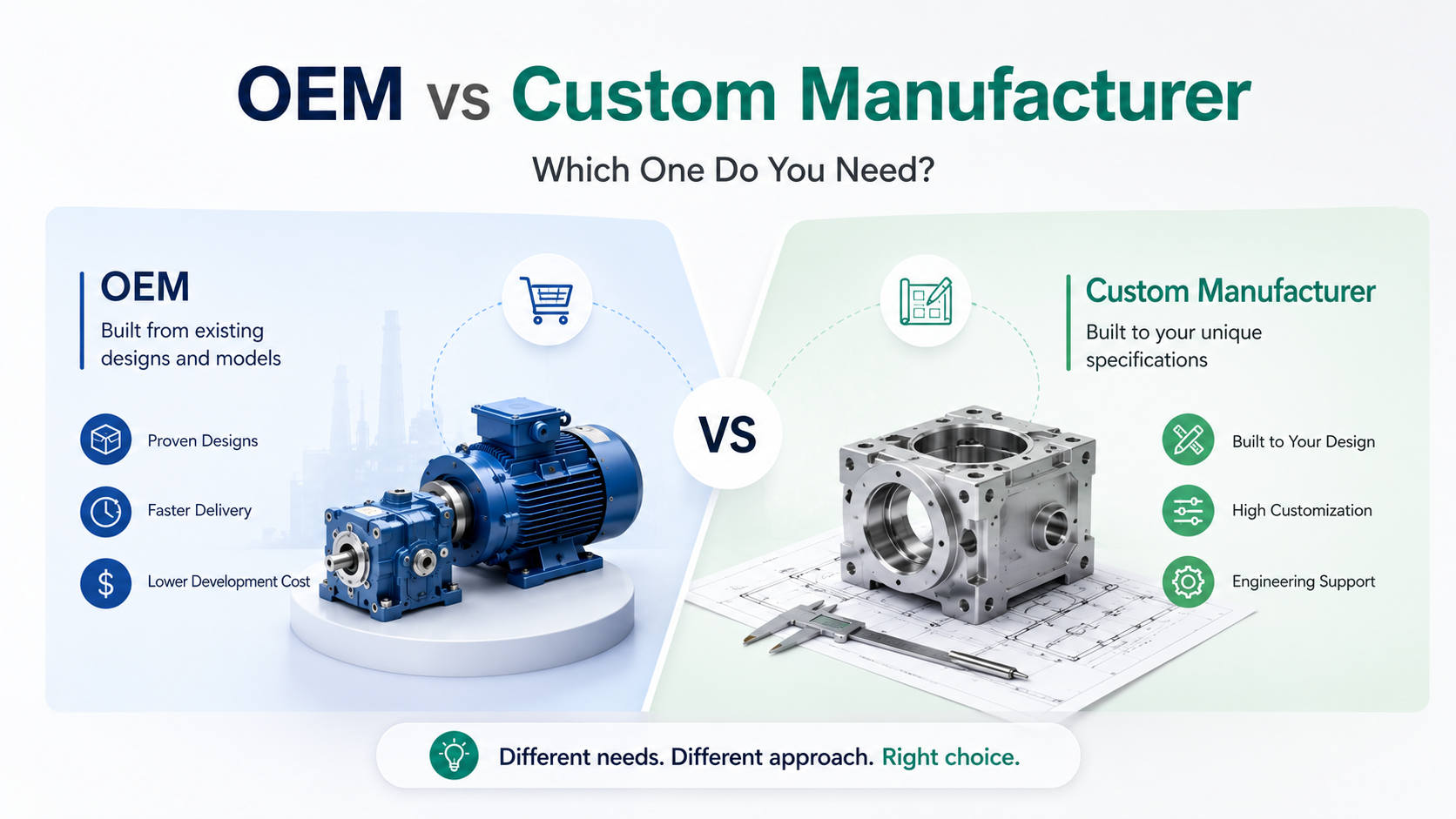
OEM
An Original Equipment Manufacturer (OEM) typically manufactures established products, equipment, systems, or components based on its own designs and product specifications.
You select from an existing product platform, sometimes with available customization.
Custom Manufacturer
A custom manufacturer produces something specifically according to a buyer's:
Drawing + Specification + Design + Material + Performance Requirement
Instead of asking:
“Which product in your catalog fits?”
You're asking:
“Can you manufacture this specific requirement?”
That difference changes the entire sourcing process.
⚙️ Scenario 1: You Need an Existing Industrial Product
Imagine you're building a production line and need an industrial gearbox.
The required specifications are already known:
15 kW motor compatibility
Specific gear ratio
Defined output torque
Required mounting arrangement
Several established companies already manufacture suitable products.
Better Fit: OEM ✓
Why?
You're not trying to invent a new gearbox.
You need a proven product that meets your technical requirements.
The buying process becomes:
Define Specification → Compare OEMs → Select Model → Purchase
This can reduce engineering effort, development risk, and lead time.
🛠️ Scenario 2: Your Requirement Doesn't Exist Off the Shelf
Now imagine you need a stainless-steel enclosure designed around unusual equipment dimensions.
It requires:
Custom Dimensions | Specific Cutouts | Special Mounting | Defined Finish | Your Drawings
A standard catalog enclosure won't work.
Better Fit: Custom Manufacturer ✓
The process becomes:
Your Requirement → Engineering Review → Prototype → Approval → Production
Here, manufacturing flexibility matters more than having an established product catalog.
🔄 Scenario 3: You Need Something Between Standard and Custom
This is where sourcing becomes interesting.
Suppose an OEM already manufactures the machine you need, but you require:
Different dimensions
Additional sensors
Your branding
Modified controls
Special materials
You may not need a completely custom manufacturer.
Some OEMs offer engineered-to-order or configurable products.
Think of the spectrum as:
Standard Product → Configured Product → Modified OEM → Fully Custom Manufacturing
Before developing something from scratch, ask whether an existing platform can be adapted.
It may save significant time and cost.
⚖️ Quick Comparison
FactorOEMCustom ManufacturerExisting product rangeUsually ✓Not necessaryBuyer-specific drawingsSometimesUsually ✓Customization flexibilityLimited to HighHighDevelopment requiredUsually lowerOften higherPrototype may be neededSometimesFrequentlyBest for unique requirementsSometimes✓Repeat standardized purchasing✓DependsNeither model is inherently better.
The right choice depends entirely on what you're trying to source.
💰 Don't Forget the Cost Equation
A standard OEM product may have a higher apparent unit price but require little engineering investment.
Custom manufacturing may involve:
Engineering + Tooling + Prototyping + Testing + Setup
But at sufficient production volumes, a custom solution may provide better performance or economics.
Ask:
Am I paying to customize something that already exists?
And equally:
Am I compromising my requirement just to fit an existing product?
The best sourcing decision often sits between those two extremes.
🔍 6 Questions to Ask Before Choosing
Use this quick checklist:
☐ Does a proven standard product already meet my requirement?
☐ How much customization do I actually need?
☐ Do I own the design or need the supplier to engineer it?
☐ What production volumes are expected?
☐ Will I need future design modifications?
☐ Who owns drawings, tooling, and intellectual property?
Your answers should quickly point you toward the right supplier model.
💡 The Bottom Line
Choose an OEM when a proven existing product or configurable platform can meet your requirements without unnecessary custom engineering.
Choose a custom manufacturer when your requirement depends on unique drawings, dimensions, materials, functionality, or production specifications.
And remember: sometimes the best solution is somewhere in between.
Don't start by asking, “Do I need an OEM or custom manufacturer?”
Start by defining what must be standard, what must be customized, and what outcome you actually need.
Once that's clear, finding the right type of manufacturing partner becomes much easier.