
Introduction
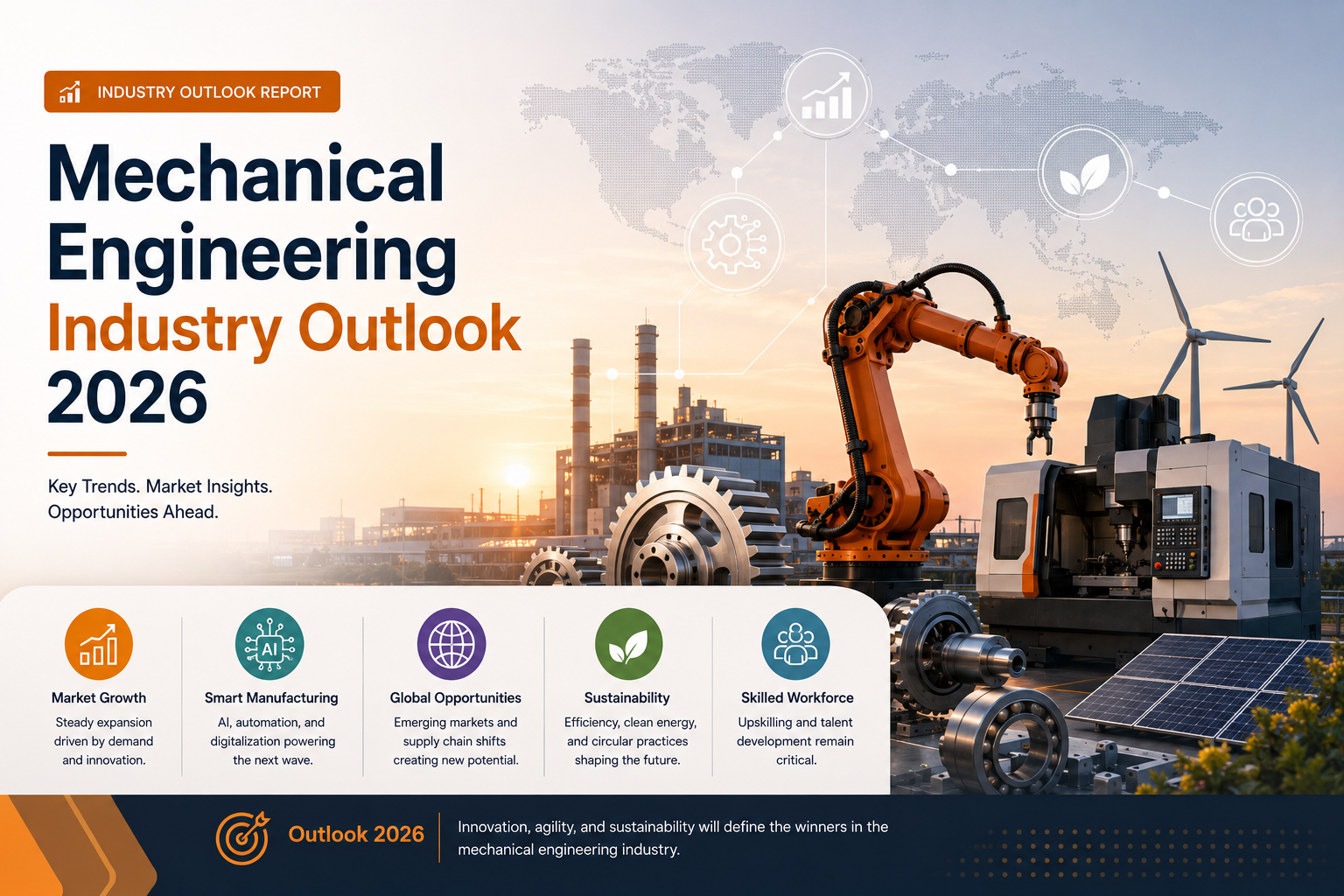
Mechanical engineering in 2026 is being reshaped by more than advances in machines.
AI, automation, supply-chain uncertainty, sustainability requirements, workforce pressures, and changing sourcing strategies are influencing how industrial companies design products, operate factories, and select suppliers.
The direction is clear:
Mechanical engineering is becoming more intelligent, connected, software-driven, and globally distributed.
Here are five shifts defining the industry in 2026.
1. AI Moves From Experimentation to Engineering Operations
AI is moving beyond pilots and into practical industrial applications.
Deloitte’s 2026 research found that 84% of surveyed manufacturers reported measurable value from AI, although only 20% of use cases had reached scale. This suggests the next challenge is no longer proving that AI works, but deploying it effectively across operations.
Where is the impact?
Quality Inspection → Computer vision identifies defects.
Predictive Maintenance → Equipment data helps anticipate failures.
Engineering → AI assists design, simulation, and optimization.
Procurement → AI supports supplier discovery and sourcing decisions.
Production → Data helps optimize processes and resource utilization.
For mechanical engineering companies, competitive advantage may increasingly depend on combining engineering expertise with intelligent digital systems.
2. Smart Manufacturing Becomes a Core Investment
Factories are evolving from isolated machines toward connected production environments.
Deloitte reports that 80% of manufacturing executives plan to allocate at least 20% of improvement budgets to smart manufacturing initiatives, reflecting how important digital operations have become to competitiveness.
Meanwhile, the World Economic Forum describes industrial operations as moving toward increasingly intelligent, connected, and autonomous systems, driven by technologies including AI and physical AI.
The 2026 Factory Stack
Machines + Sensors + Automation + Software + AI + People
The opportunity isn't simply to automate more.
It is to make the entire manufacturing system more visible, adaptable, and responsive.
3. Supply Chains Shift From Lowest Cost to Resilience
For years, industrial sourcing focused heavily on price.
That equation is changing.
Geopolitical uncertainty, trade policies, logistics disruptions, and supplier concentration risks are forcing manufacturers to reconsider how and where they source critical components. Deloitte notes that growing global supply-chain complexity is increasing the need for more resilient and responsive sourcing models.
Procurement priorities are shifting:
Then: Lowest Price → Single Supplier → Global Sourcing
Now: Total Value → Multiple Options → Resilient Sourcing
Buyers increasingly need better visibility into supplier capabilities, geography, capacity, certifications, lead times, and alternative sources.
For suppliers, being digitally discoverable and clearly communicating manufacturing capabilities becomes increasingly important.
4. Engineers and Automation Will Work Together
The rise of AI and automation doesn't eliminate the importance of engineering talent.
It changes what that talent does.
Routine analysis, documentation, monitoring, and repetitive production tasks can increasingly be supported by software and automation.
Engineers can spend more time on:
Complex problem-solving
Product innovation
Design optimization
System integration
Manufacturing strategy
Research highlighted by the World Economic Forum shows that industrial transformations combining technology investment with workforce capability development tend to perform better than technology initiatives implemented in isolation.
The winning model isn't people versus automation.
It's people + automation + intelligence.
5. Sustainability Becomes an Engineering Requirement
Sustainability is increasingly moving from corporate reporting into engineering decisions.
Mechanical engineers are being asked to consider:
Energy efficiency | Material usage | Equipment lifecycle | Recyclability | Manufacturing waste | Carbon impact
This creates opportunities across renewable-energy equipment, efficient motors and machinery, lightweight materials, remanufacturing, electrification, and circular manufacturing.
Suppliers able to demonstrate efficient processes, traceable materials, and sustainable manufacturing capabilities may gain an advantage as buyer expectations evolve.
2026 Opportunity Radar
AreaOutlookAI in Manufacturing🔥 High GrowthIndustrial Automation🔥 High GrowthSmart Manufacturing🔥 High GrowthDigital Engineering📈 AcceleratingSupplier Digitalization📈 AcceleratingSustainable Manufacturing📈 AcceleratingTraditional Manual Processes⚠️ Under PressureWhat Should Buyers and Suppliers Watch?
For Buyers
Look beyond price. Evaluate suppliers on capability, resilience, technology readiness, quality, capacity, and long-term reliability.
For Suppliers
Digital visibility matters. Buyers increasingly expect to understand your products, equipment, certifications, capabilities, capacity, and expertise before the first conversation.
Outlook 2026
Mechanical engineering isn't disappearing into software.
It is becoming more powerful because of software, AI, automation, and connected data.
The companies positioned to benefit most will be those that combine traditional engineering strengths with digital capabilities, resilient supplier networks, skilled people, and smarter manufacturing systems.
2026 will reward companies that don't simply manufacture better products, but build smarter ways to design, source, manufacture, and deliver them.