
Introduction
Modernizing a manufacturing plant doesn't always mean demolishing everything and starting again.
For established manufacturers, the real challenge is more complex:
How do you introduce modern technology into a running factory without disrupting the production that keeps the business alive?
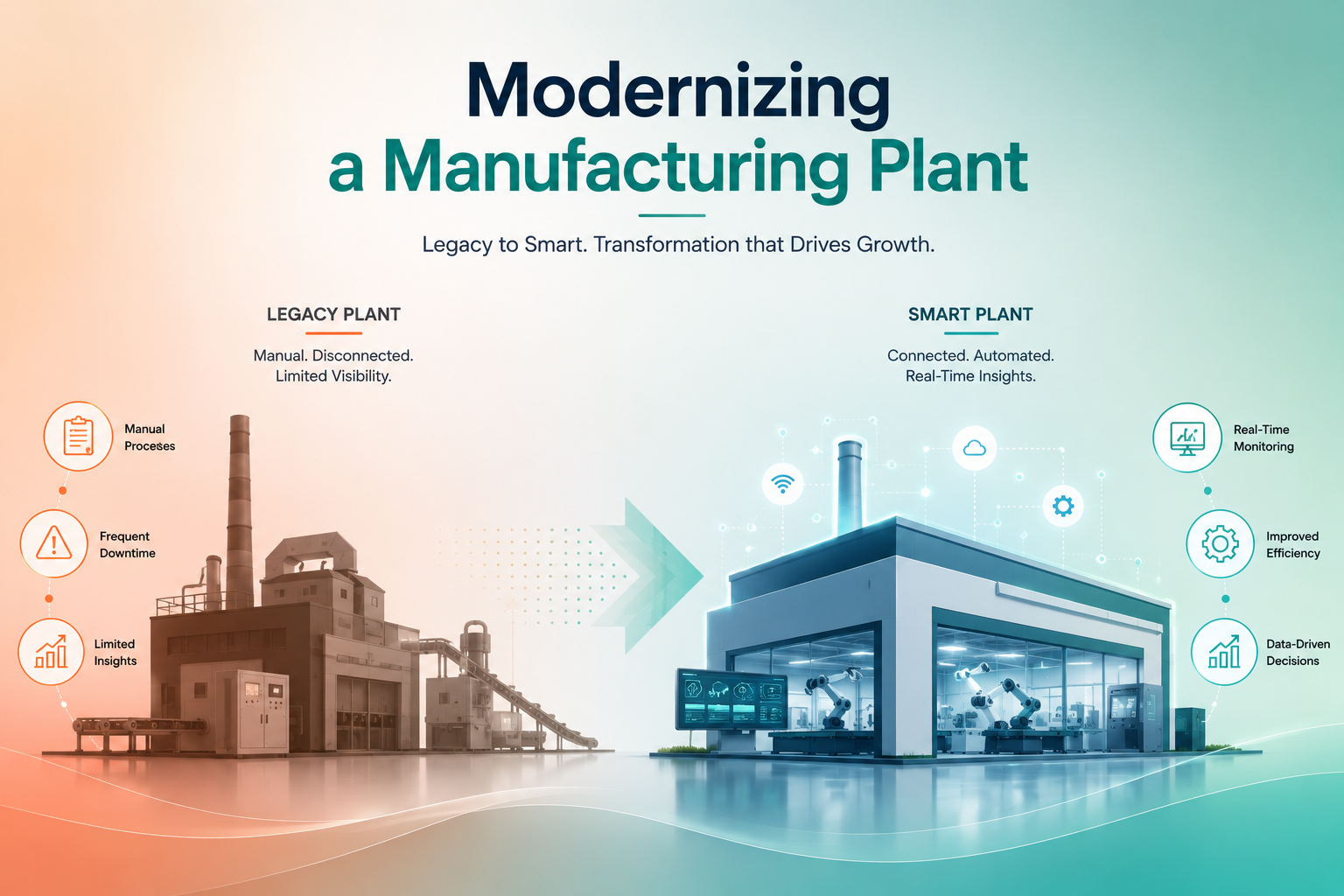
A growing manufacturer faced exactly this situation. Its plant had reliable machinery, experienced operators, and established production processes, but years of incremental expansion had created disconnected systems, manual workflows, and limited production visibility.
The objective was clear: modernize without unnecessary replacement.
🏭 The Challenge: A Factory Built Across Different Eras
The plant had evolved over many years.
Some machines were relatively modern. Others used older control systems. Production information was recorded manually, maintenance depended heavily on operator experience, and management had limited real-time visibility.
The situation looked something like this:
Legacy Machines + Manual Records + Isolated Systems + Experienced People
The factory worked.
But scaling it was becoming increasingly difficult.
Four major challenges emerged:
Limited real-time production visibility
Increasing maintenance and downtime concerns
Manual reporting and data collection
Difficulty integrating older equipment with newer systems
Replacing every machine was financially unrealistic.
A smarter modernization strategy was needed.
🔍 Step 1: Modernize Based on Business Impact
The project began by identifying where modernization would create the greatest operational value.
Instead of asking:
“Which machines are oldest?”
The team asked:
“Where are we losing the most time, visibility, quality, or productivity?”
Each production area was evaluated across:
Downtime | Manual Work | Quality Issues | Data Availability | Production Bottlenecks
This helped prioritize investments.
Some machines needed control upgrades.
Others only needed sensors or better data collection.
Certain manual processes were candidates for automation, while others worked perfectly well as they were.
Key Principle
Modernize where value exists. Don't automate simply because automation is possible.
⚙️ Step 2: Connect Old and New Equipment
One of the biggest challenges was creating connectivity across machines from different generations.
The modernization approach introduced a layered architecture:
Existing Machines
↓
Sensors / PLCs / Data Acquisition
↓
Connected Production Data
↓
Dashboards & Monitoring
↓
Management Decisions
Instead of replacing functional equipment, selected machines were upgraded or connected to digital monitoring systems.
Production teams could begin tracking information such as machine status, output, downtime, cycle performance, and material consumption more consistently.
The factory gradually became visible as one connected operation rather than a collection of isolated machines.
📊 Step 3: Turn Production Data Into Decisions
Collecting data alone doesn't make a factory smart.
The information has to help someone make a better decision.
Dashboards were introduced to give different teams relevant operational visibility.
Operators Needed:
Machine Status → Targets → Alerts
Production Managers Needed:
Output → Downtime → Efficiency → Bottlenecks
Management Needed:
Performance Trends → Capacity → Costs → Improvement Opportunities
This reduced dependence on spreadsheets and end-of-shift reports.
Problems could be identified closer to when they happened rather than discovered days later.
🔧 Step 4: Modernize in Phases
Attempting to transform the entire plant simultaneously would have created unnecessary operational risk.
Instead, modernization followed a phased approach:
Pilot Area → Measure Results → Improve → Expand
The first implementation focused on a production area where improvement could be measured clearly.
Once the technology and workflows proved effective, the approach was expanded to additional machines and departments.
This allowed employees to adapt gradually while keeping production running.
📈 The Outcome
The modernization created improvements beyond new technology.
The manufacturer gained:
✓ Better real-time production visibility
✓ Faster identification of downtime and bottlenecks
✓ Reduced dependence on manual reporting
✓ Improved coordination between production and maintenance
✓ Better use of existing machinery
✓ A scalable digital foundation for future automation
Most importantly, modernization became an ongoing improvement strategy, not a one-time technology project.
💡 The Key Lesson
A smart factory isn't defined by how many robots it has.
It is defined by how effectively machines, people, processes, and information work together.
For manufacturers operating established plants, the path forward doesn't always require replacing everything that already works.
Sometimes the smartest transformation is:
Keep what works. Connect what is isolated. Automate what creates value. Measure what matters.
That is how a traditional manufacturing plant can evolve into a smarter, more connected operation without losing the strengths that made it successful in the first place.