
Introduction
A small CNC machining company may have advanced equipment, skilled engineers, available production capacity, and years of manufacturing experience.
Yet one challenge remains:
How does the right buyer discover them?
For decades, smaller industrial suppliers have relied heavily on local networks, referrals, trade exhibitions, sales representatives, and existing customer relationships.
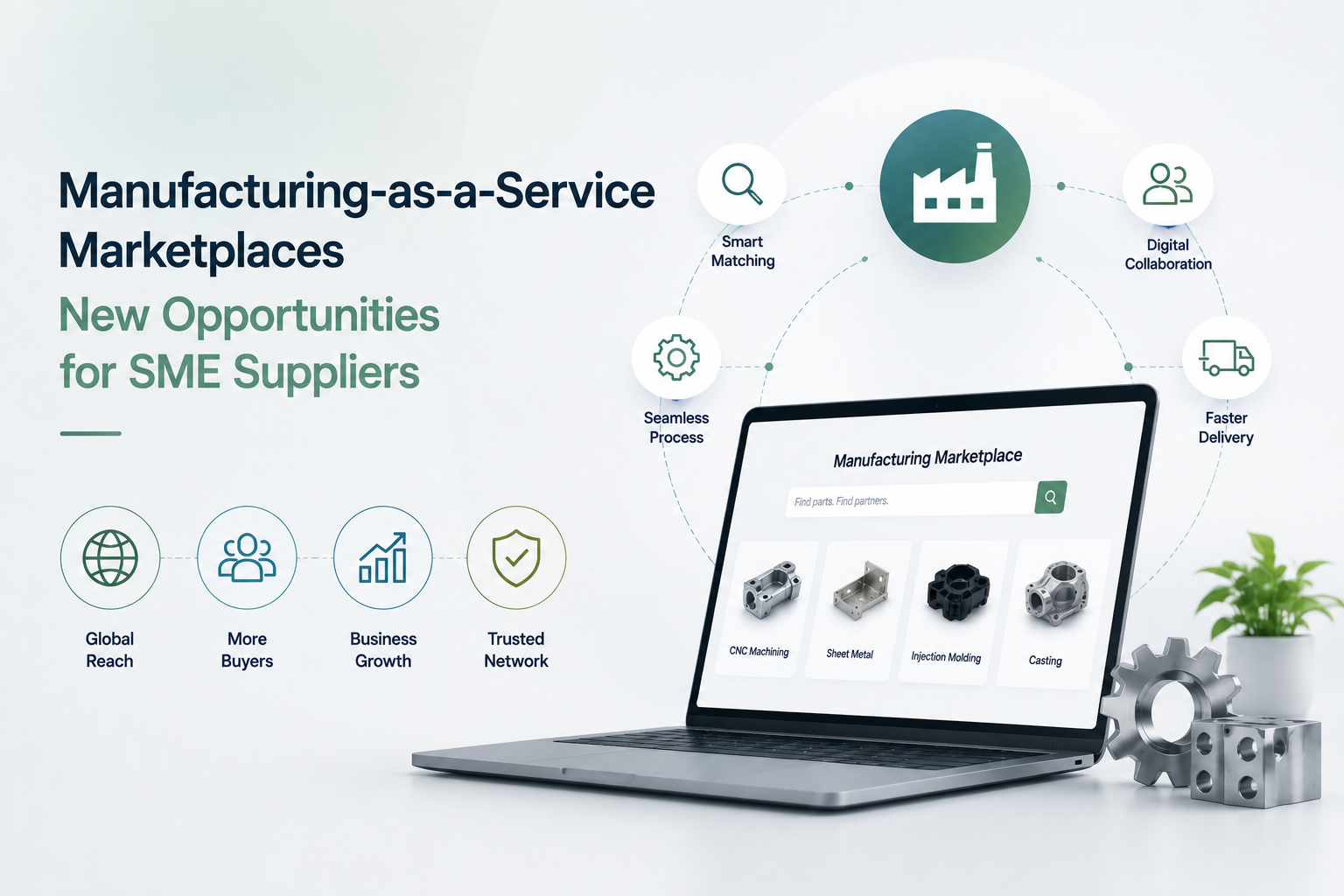
Manufacturing-as-a-Service (MaaS) marketplaces are beginning to change that model by creating digital networks that connect manufacturing demand with available supplier capabilities.
For SMEs, this could open an entirely new route to market.
🏭 What Is Manufacturing-as-a-Service?
Think of it as manufacturing capacity available through a connected digital marketplace.
Instead of a buyer manually searching for manufacturers, contacting companies individually, and determining whether each supplier has the required capabilities, a digital platform can help connect the requirement with suitable manufacturers.
A typical workflow looks like:
Buyer Requirement → Technical Evaluation → Supplier Matching → Quotation → Production → Delivery
Depending on the platform, buyers may source capabilities such as:
CNC machining
Sheet metal fabrication
Injection molding
3D printing
Casting
Forging
Surface finishing
Recent research has explored MaaS platforms as ecosystems capable of connecting manufacturers with distributed production resources while supporting processes such as supplier selection, quotation, production, and quality management.
🌍 Why This Matters for SME Manufacturers
Large manufacturers usually have established sales teams, distributor networks, strong search visibility, and long-standing customer relationships.
An SME may have equally strong technical capabilities but significantly lower market visibility.
Digital manufacturing marketplaces can begin to level that playing field.
Traditional Model
Who you know → Local visibility → Enquiries → Orders
Marketplace Model
What you can manufacture → Digital discovery → Relevant opportunities → Orders
That is an important shift.
A supplier's capabilities, equipment, materials, certifications, capacity, and performance can become part of how buyers discover them.
🔎 Buyers Are Also Looking for Better Supplier Discovery
The opportunity isn't driven only by suppliers wanting more business.
Industrial buyers face their own challenges.
Finding a supplier for a specific manufacturing requirement can involve dozens of searches, websites, emails, referrals, and quotation requests.
The problem becomes even harder when requirements involve:
Specific material + Manufacturing process + Tolerance + Certification + Quantity + Geography
Digital marketplaces can organize fragmented supplier information and make manufacturers easier to discover and evaluate.
For procurement teams, this potentially means a broader supplier pool and faster sourcing.
For SMEs, it means buyers who previously would never have known they existed can potentially find them.
⚙️ Idle Capacity Can Become an Opportunity
Manufacturing capacity isn't always fully utilized.
A CNC shop may have available machine hours.
A fabrication company may have spare laser-cutting capacity.
A molding supplier may have production slots between larger orders.
Traditionally, finding suitable demand for this capacity requires active selling.
A connected manufacturing marketplace could help match:
Buyer Demand ↔ Available Supplier Capability
This can potentially improve machine utilization while giving buyers access to additional production capacity.
📊 But Digital Visibility Will Require Better Supplier Data
Simply registering on a marketplace won't guarantee opportunities.
As industrial sourcing becomes more digital, suppliers will need to present structured, credible information.
The Digital Supplier Profile
Capabilities — What can you actually manufacture?
Equipment — What machines and processes are available?
Materials — What do you regularly work with?
Certifications — Which standards do you meet?
Capacity — What volumes can you handle?
Industries — Where do you have experience?
Performance — Can buyers trust your delivery and quality?
The better this information becomes, the better digital platforms and AI systems can match suppliers with relevant requirements.
🚀 From Industrial Directory to Manufacturing Network
Traditional B2B directories answered a simple question:
“Which companies exist?”
The emerging generation of manufacturing marketplaces aims to answer something much more useful:
“Which supplier is best suited to manufacture what I need?”
That distinction could reshape industrial sourcing.
For SME suppliers, the opportunity is significant.
A manufacturer no longer needs to be the biggest company or have the largest sales organization to become visible.
In an increasingly connected manufacturing ecosystem, capability itself can become discoverable.
And as AI-driven supplier matching improves, the future of industrial sourcing may become less about who buyers already know and more about who is genuinely best equipped to deliver.