
Introduction
You’re looking for a company to make a product or component.
One supplier calls itself a manufacturer. Another says it’s an OEM. A third offers contract manufacturing.
They all manufacture things, so what’s actually different?
The terms are often used interchangeably, but they can describe very different business relationships.
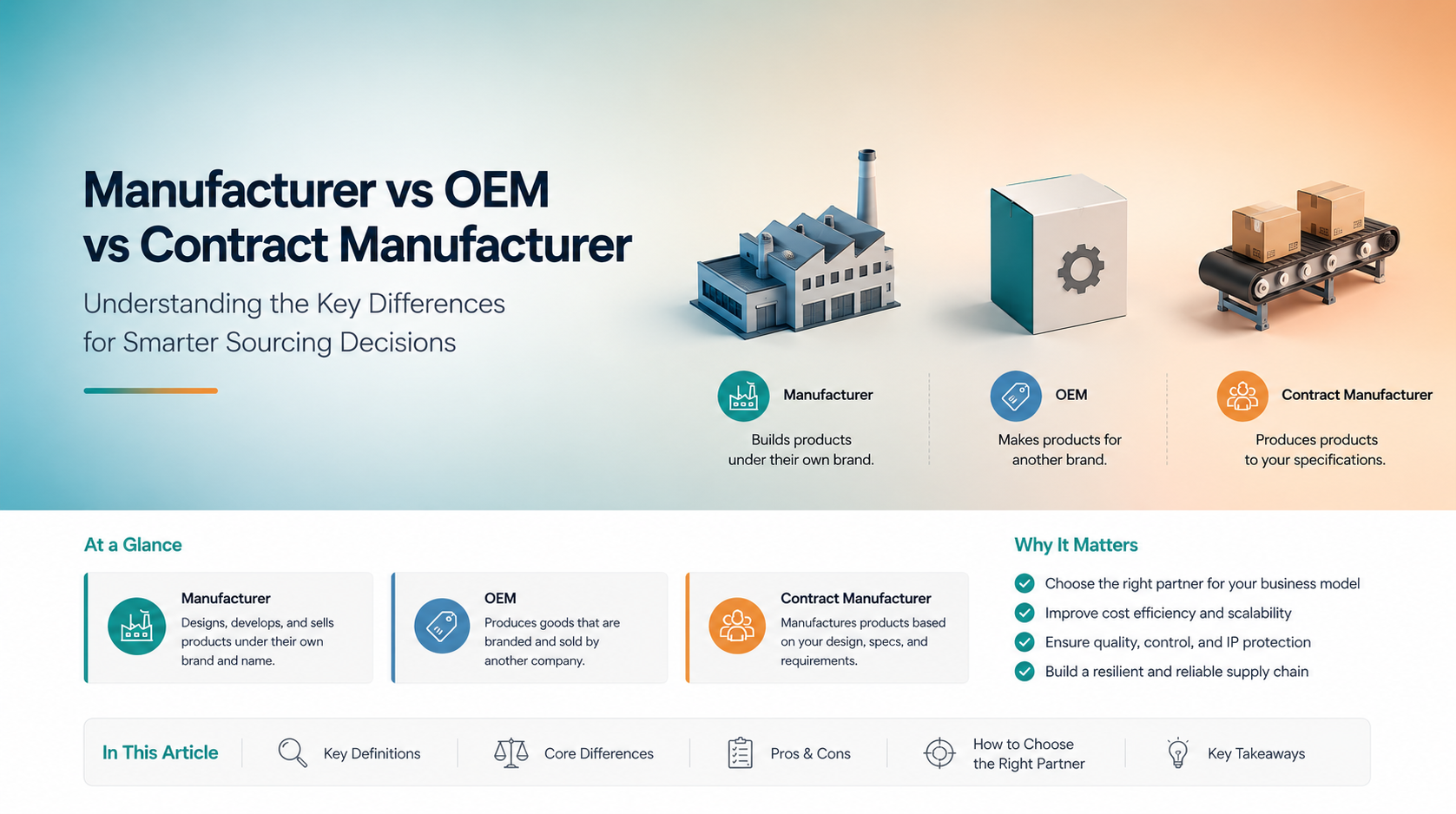
The simplest distinction: Who designs the product, who manufactures it, and whose brand ultimately goes on it?
Let’s break it down.
🏭 1. What Is a Manufacturer?
Manufacturer is the broadest term.
A manufacturer is simply a company that converts raw materials, components, or subassemblies into finished or semi-finished products.
Examples include:
A company manufacturing industrial pumps
A factory producing steel fasteners
A CNC company machining precision components
A business manufacturing conveyor systems
A manufacturer may sell products under its own brand, manufacture components for other companies, or do both.
Think of it as:
Materials → Manufacturing Process → Product
So when a supplier says “We are a manufacturer,” you still need to ask:
“What exactly do you manufacture, and under what business model?”
⚙️ 2. What Is an OEM?
OEM stands for Original Equipment Manufacturer, but this term can become confusing because industries use it differently.
Generally, an OEM is associated with producing products or components that become part of another company's final offering, or with owning the design and specification of a finished product.
Consider an automotive company.
It may design and sell a vehicle under its own brand while sourcing:
Sensors + Bearings + Motors + Electronic Modules + Fasteners
from specialized manufacturers.
Depending on industry terminology, both the vehicle company and some component producers may be described as OEMs.
For buyers, the important questions are:
Who owns the design?
Whose specifications are being followed?
Whose brand appears on the final product?
Don't rely on the term OEM alone. Understand the actual relationship.
🛠️ 3. What Is a Contract Manufacturer?
A contract manufacturer produces products on behalf of another company, typically according to that company's drawings, specifications, formulations, or requirements.
Imagine you have designed a new industrial IoT device.
You own:
Product Design + Intellectual Property + Brand
But you don't own a factory.
A contract manufacturer could handle:
Component Sourcing → Manufacturing → Assembly → Testing → Packaging
You then sell the finished product under your brand.
In simple terms: You own the product. They provide the manufacturing capability.
This model is common across electronics, medical devices, automotive components, consumer products, industrial equipment, and many other sectors.
⚖️ Quick Comparison
ManufacturerOEMContract ManufacturerManufactures products✓✓✓May own product designSometimesOftenUsually noProduces for other companiesSometimesOftenYesCustomer provides specificationsSometimesVariesUsuallyPrivate/confidential productionVariesVariesCommonThe boundaries aren't always perfect, which is exactly why buyers should evaluate capabilities and commercial relationships, not labels alone.
🔍 Which One Do You Need?
Scenario A
“I need 500 standard industrial pumps.”
You probably need an established manufacturer with an existing product range.
Scenario B
“I need components that will become part of the equipment we sell.”
You may be looking for an OEM or specialized component manufacturer.
Scenario C
“We designed a product but need someone to manufacture it for us.”
A contract manufacturer is likely the better fit.
Scenario D
“I want an existing product customized and sold under my brand.”
You may need an OEM/private-label manufacturing arrangement, depending on the product and supplier.
📋 5 Questions to Ask Any Potential Supplier
Before deciding what category a supplier belongs to, ask:
☐ Do you manufacture this product yourself?
☐ Which processes are performed in-house?
☐ Can you manufacture according to our drawings?
☐ Who owns the tooling and intellectual property?
☐ Can you support prototype, low-volume, and mass production?
These answers tell you far more than the label on the supplier's website.
💡 The Key Takeaway
Manufacturer, OEM, and contract manufacturer are not simply three names for the same supplier.
They describe different ways companies participate in the manufacturing ecosystem.
When sourcing, don't begin by asking:
“Are you an OEM?”
Start with:
“Can you manufacture what we need, under the business model, specifications, quality requirements, volumes, and ownership structure we require?”
Because ultimately, choosing the right manufacturing partner isn't about finding the right label.
It's about finding the right capability and the right fit.