
Introduction
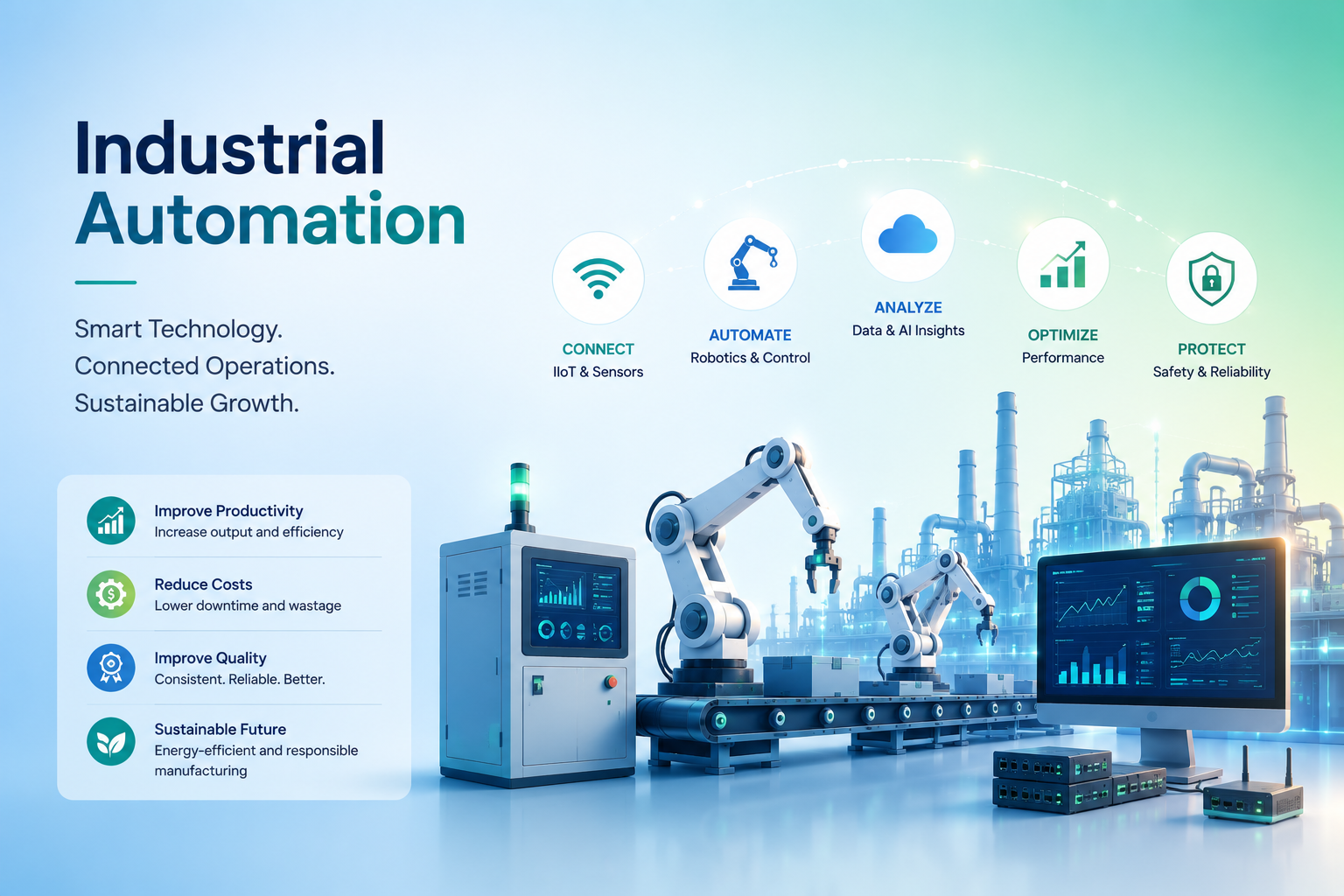
Industrial automation is entering a new phase.
For decades, automation primarily meant replacing repetitive manual processes with PLCs, machines, robots, sensors, and control systems.
In 2026, the definition is expanding.
Factories are increasingly connecting automation with AI, industrial software, machine vision, real-time data, robotics, and cloud-edge technologies to create production systems that can not only operate automatically but also become more intelligent.
The shift: Automated Machines → Connected Factories → Intelligent Operations
Here are the major forces shaping the industrial automation market.
1. Automation Demand Extends Beyond Labor Replacement
The traditional business case for automation was straightforward:
Produce Faster + Reduce Manual Work + Improve Repeatability
Those benefits remain important, but manufacturers now have broader objectives.
Companies are investing in automation to address:
Skilled labor shortages
Production consistency
Energy efficiency
Quality requirements
Manufacturing flexibility
Real-time operational visibility
Automation is therefore becoming less about replacing individual tasks and more about improving the performance of the entire production system.
2. Industrial Robots Continue to Transform Production
Robotics remains one of the most visible areas of industrial automation.
According to the International Federation of Robotics, global factories had approximately 4.28 million industrial robots operating in 2023, reflecting how deeply robotics has become embedded in modern manufacturing.
Robots are now widely used across:
Automotive | Electronics | Metalworking | Plastics | Logistics | Food | Pharmaceuticals
The next opportunity is increasingly about flexibility.
Traditional robots typically operate within highly structured environments, while collaborative robots, machine vision, and AI-assisted robotic systems are expanding the range of tasks that can potentially be automated.
What buyers increasingly want:
Faster deployment → Easier programming → Greater flexibility → Better ROI
3. AI Is Becoming the Intelligence Layer
A major transformation is happening above traditional automation hardware.
Consider a production machine generating thousands of data points.
Traditional automation may respond:
Temperature exceeds limit → Stop machine.
An intelligent system could potentially ask:
Why is temperature increasing, what is likely to happen next, and what action should be taken before production is affected?
This is where AI, analytics, and predictive technologies are becoming increasingly relevant.
Key applications include:
Predictive Maintenance
AI-Based Quality Inspection
Production Optimization
Anomaly Detection
Energy Optimization
Demand & Production Planning
The result is a shift from reactive automation toward predictive operations.
4. The Connected Factory Becomes the Bigger Opportunity
Automation systems historically operated in silos.
A PLC controlled one machine.
SCADA monitored a process.
ERP managed business operations.
Quality teams maintained separate records.
The modern factory is increasingly connecting these layers.
Emerging Architecture
Sensors & Machines
↓
PLC / Control Systems
↓
SCADA / MES
↓
Industrial Data Platforms
↓
ERP / Business Systems
↓
Analytics & AI
This connectivity allows production information to move from the shop floor into operational and business decision-making.
For automation suppliers, this creates opportunities beyond hardware in integration, industrial software, cybersecurity, connectivity, analytics, and lifecycle services.
5. Asia Remains Central to Automation Growth
Asia continues to play a major role in global industrial automation because of its enormous manufacturing base.
China, Japan, South Korea, India, and Southeast Asia represent important markets across robotics, electronics manufacturing, automotive production, machinery, and process industries.
But automation demand varies significantly.
Large manufacturers may pursue fully connected smart factories.
SMEs may begin with:
One Machine → One Bottleneck → One Automation Project
This makes modular and scalable automation increasingly important.
📊 Industrial Automation Opportunity Radar
TechnologyMarket DirectionIndustrial Robotics🔥 StrongAI & Machine Vision🔥 Rapid GrowthPLC & Control Systems📈 Established GrowthIndustrial IoT🔥 ExpandingPredictive Maintenance📈 AcceleratingCollaborative Robots📈 ExpandingSmart Factory Software🔥 High OpportunityManual Data Collection⚠️ Declining6. What This Means for Buyers and Suppliers
🏭 For Industrial Buyers
The question is no longer simply:
“Which automation product should we buy?”
Buyers increasingly need to evaluate integration capability, scalability, interoperability, cybersecurity, lifecycle support, and measurable ROI.
⚙️ For Suppliers
Selling hardware alone may become increasingly difficult.
Customers are looking for partners capable of connecting:
Product + Engineering + Software + Integration + Support
Suppliers that clearly communicate their technical capabilities, industry experience, installed base, and integration expertise will be better positioned for increasingly complex projects.
Outlook
Industrial automation is evolving from a collection of machines and control systems into the digital nervous system of modern manufacturing.
Robotics will continue expanding. AI will add intelligence. Connected systems will improve visibility. And manufacturers will increasingly expect automation investments to deliver measurable operational outcomes.
The biggest opportunity may therefore not belong to one technology.
It lies in connecting machines, people, software, data, and intelligence into one productive manufacturing ecosystem.
For buyers and suppliers alike, the next era of industrial automation will be defined not simply by how much can be automated, but by how intelligently everything can work together.