
Introduction
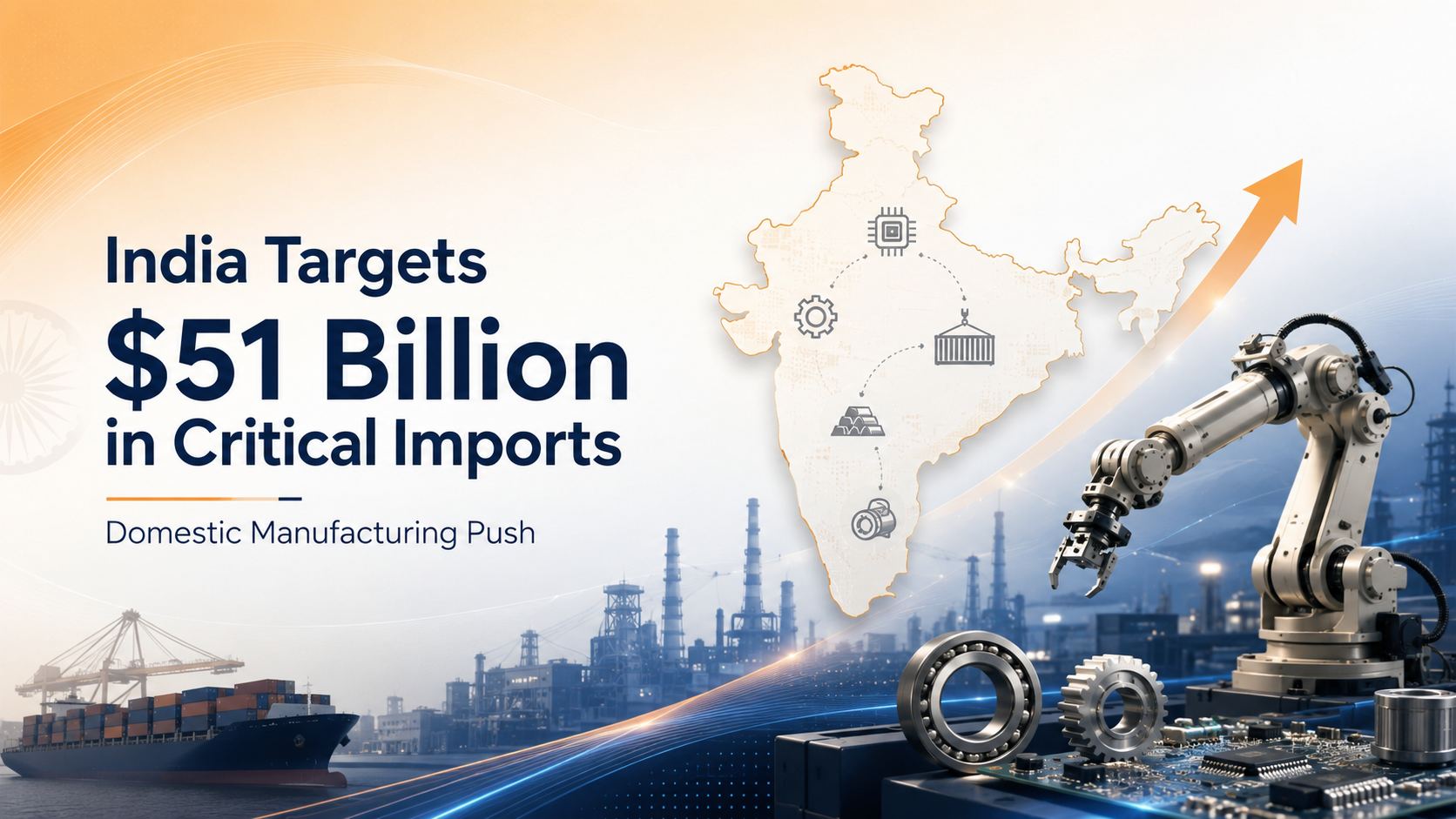
India is preparing a fresh push to manufacture more critical products domestically, with the government identifying around $51 billion worth of imports that could become priority areas for local production.
According to a Reuters report published on July 16, 2026, government analysis identified nearly $398 billion worth of imports with potential for substitution through domestic manufacturing. From this larger pool, about $51 billion in critical imports, covering roughly 100 priority items, are expected to receive more immediate attention. eted products span industries including textiles, footwear, electric vehicles, and solar energy, reflecting India’s broader effort to reduce dependence on overseas supply chains and strengthen domestic manufacturing capacity. Numbers at a Glance
$775 billion India’s total goods imports in the 12 months ended March 2026.
$398 billion Imports identified through internal analysis as having potential for domestic substitution.
$51 billion Imports considered critical enough for focused manufacturing action.
Around 100 items Products expected to be prioritised for immediate intervention. gures show that the initiative is not limited to one industry. It is part of a broader attempt to identify specific gaps where India continues to rely heavily on imported products, components, or manufacturing inputs.
Why Is India Focusing on These Imports?
Supply-chain disruptions and geopolitical uncertainty have increased the importance of domestic production in strategic sectors.
Reuters reported that India imported around $132 billion worth of goods from China during fiscal year 2025–26, making China its largest source of imports. The government’s renewed manufacturing push is partly aimed at reducing vulnerabilities created by concentrated dependence on overseas suppliers. lenge, however, is not simply identifying products that can theoretically be manufactured in India.
Domestic alternatives must also compete on:
Price
Quality
Production capacity
Lead time
Technology
Supply consistency
Reuters cited examples such as footwear moulds and solar photovoltaic cells where imported products can currently be more competitive in cost or delivery speed. t Could the Government Do Next?
The reported plan could involve a combination of policy measures rather than a single manufacturing scheme.
According to Reuters, possible approaches include providing incentives, encouraging joint ventures with international manufacturers, and attracting technology or manufacturing partnerships from countries such as South Korea, Taiwan, Germany, and Italy. State-owned enterprises could also be encouraged to participate in selected areas. gests the strategy may focus not only on replacing imports directly, but also on building the technical capabilities required to manufacture more complex products locally.
🔧 What This Could Mean for Indian Suppliers
For Indian manufacturers and industrial suppliers, the significance lies in the potential development of new domestic supply chains.
When production of an imported product moves to India, demand does not stop with the final manufacturer.
A new manufacturing ecosystem may require:
Components → Tooling → Machinery → Automation → Electrical systems → Materials → Testing → Packaging → Maintenance
This means opportunities could eventually extend to MSMEs, contract manufacturers, machine builders, precision engineering companies, automation specialists, component suppliers, and industrial service providers.
That is an implication of the localisation strategy rather than a confirmed government allocation to these supplier categories.
⚠️ Import Substitution Will Not Happen Automatically
India has already introduced initiatives such as Make in India and Production Linked Incentive programmes to strengthen local manufacturing.
Reuters noted that while previous programmes have achieved results in selected industries, they have not dramatically reduced India’s overall import dependence. phase will therefore depend on whether domestic manufacturers can become globally competitive, not simply whether imported products are identified for replacement.
The Bigger Picture
The $51 billion figure represents more than a list of imports.
It highlights areas where India believes stronger domestic manufacturing could improve supply-chain resilience and reduce strategic dependency.
For Indian industry, the opportunity could extend well beyond the roughly 100 products themselves.
Every product successfully localised has the potential to create a wider network of manufacturers, component suppliers, technology providers, engineering companies, and industrial service businesses around it.
The real test will now be turning identified import opportunities into commercially competitive manufacturing capacity at scale.