
Introduction
India has taken another major step toward building a stronger domestic semiconductor ecosystem.
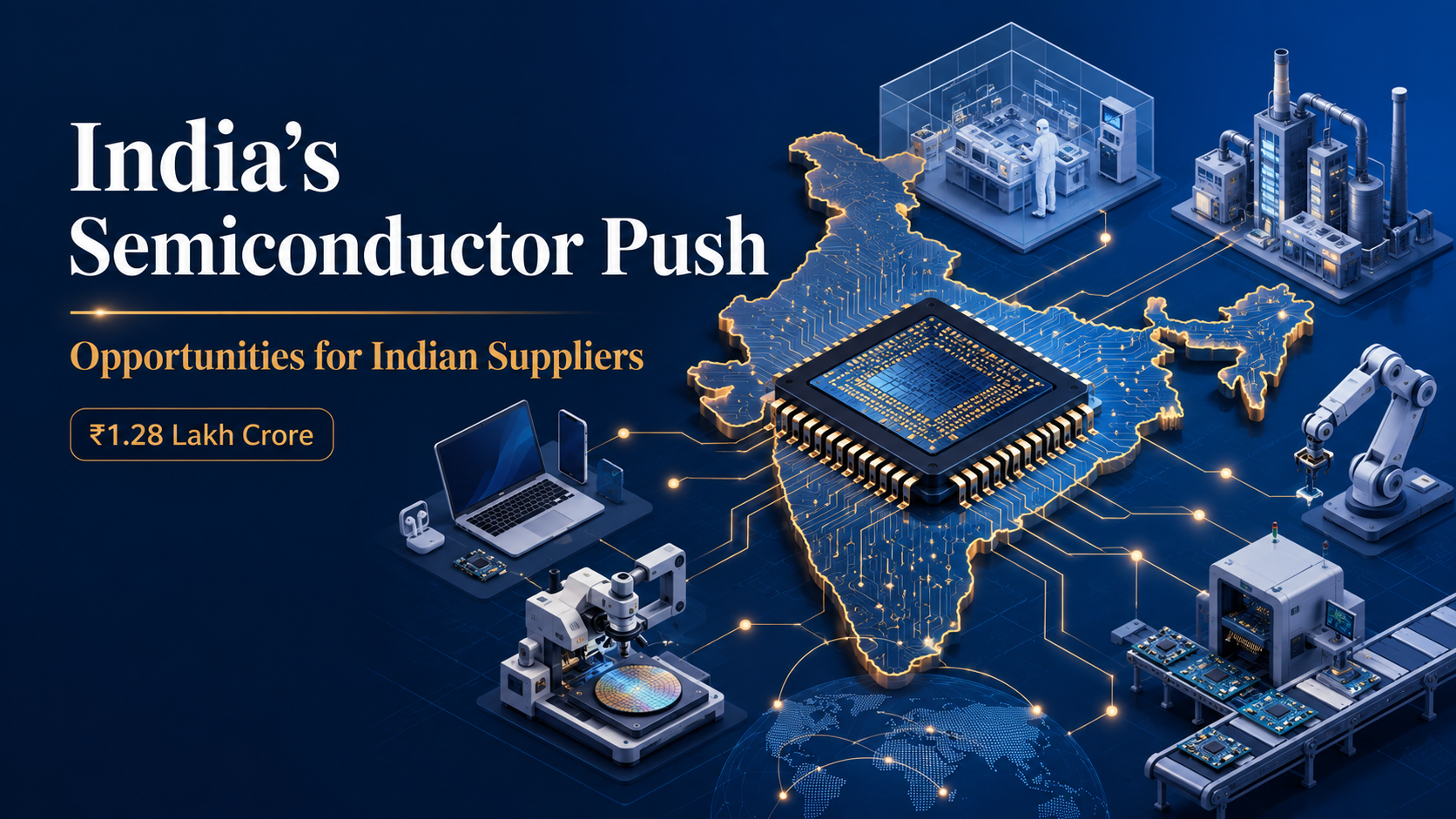
On July 15, 2026, the Union Cabinet approved the next phase of the country’s semiconductor push, with approximately ₹1.28 lakh crore in fresh allocation under the expanded programme. The initiative is aimed at strengthening domestic semiconductor manufacturing, design, research, and the wider ecosystem needed to support the industry.
But this development is not relevant only to semiconductor fabs or large electronics companies.
It could create opportunities across a much wider network of Indian manufacturers, engineering companies, automation specialists, component suppliers, infrastructure providers, and technology businesses.
🏭 Semiconductor Manufacturing Needs an Entire Ecosystem
A semiconductor facility does not operate in isolation.
Behind every chip manufacturing or packaging facility is a complex industrial supply chain involving equipment, utilities, precision components, clean environments, automation, testing, logistics, and highly specialized materials.
That means semiconductor expansion can generate demand across areas such as:
Precision machining and fabrication
Industrial automation and control systems
Electrical panels and power distribution
Cleanroom equipment and HVAC systems
Specialty gases and chemicals
Sensors and instrumentation
Robotics and material handling
Industrial pumps, valves, and piping
Electronic components and assemblies
Testing and inspection equipment
Packaging and logistics
India’s earlier semiconductor policy already targeted more than just fabs, with support extending to areas such as packaging, sensors, display technologies, and other parts of the semiconductor ecosystem.
🔧 Opportunity for Precision Engineering Suppliers
Semiconductor manufacturing demands extremely high levels of accuracy and reliability.
This creates opportunities for Indian suppliers capable of producing:
Precision-machined components
Stainless-steel assemblies
Custom enclosures
Fixtures and tooling
High-purity piping components
Specialized fabrication
Suppliers that can demonstrate strong quality systems, repeatability, traceability, and technical documentation could find themselves serving entirely new categories of customers.
For many SMEs, the opportunity may not be to manufacture chips directly, but to become a trusted supplier to the companies building and operating semiconductor facilities.
🤖 Automation Could See Significant Demand
Semiconductor manufacturing is highly automated.
Production environments rely on advanced control systems, robotics, sensors, machine vision, monitoring platforms, and data-driven manufacturing systems.
This creates potential opportunities for:
PLC and SCADA integrators
Control panel manufacturers
Industrial IoT companies
Robotics integrators
Machine vision specialists
Factory software providers
As India expands its semiconductor infrastructure, local automation companies may increasingly find opportunities to participate in plant development, utility systems, material movement, inspection, maintenance, and production support.
🧪 Cleanrooms and Specialized Infrastructure Matter Too
Semiconductor facilities require tightly controlled environments.
Temperature, humidity, airborne particles, vibration, contamination, water quality, and gas distribution must often be managed with exceptional precision.
This creates demand for companies specializing in:
🔹 Cleanroom construction 🔹 HVAC and filtration 🔹 Ultra-pure water systems 🔹 Gas handling systems 🔹 Industrial monitoring 🔹 Facility automation 🔹 Specialized safety systems
The semiconductor supply chain is therefore much broader than electronics manufacturing alone.
📈 A Bigger Opportunity for Indian Supplier Development
India’s semiconductor strategy is increasingly focused on creating a long-term domestic ecosystem rather than relying heavily on imported capabilities.
Industry groups have described Semicon 2.0 as an important foundation for expanding India’s semiconductor manufacturing and design ecosystem.
For Indian suppliers, however, entering this ecosystem will require preparation.
Companies may need stronger:
Quality certifications
Technical documentation
Process traceability
Clean manufacturing practices
Engineering capability
Compliance standards
Digital supplier profiles
The companies that prepare early may be better positioned when larger semiconductor projects begin looking for qualified domestic partners.
🚀 Beyond Chips: A New Supplier Ecosystem
India’s semiconductor push should not be viewed as an opportunity reserved for a handful of major corporations.
Every large manufacturing investment creates layers of suppliers around it.
Fabs need equipment. Equipment manufacturers need components. Facilities need automation. Production needs maintenance. Operations need materials, engineering, and logistics.
That is where thousands of Indian manufacturers and industrial service providers could participate.
The real opportunity may therefore be much larger than semiconductor manufacturing itself.
It is the creation of a new industrial supplier ecosystem around one of India’s most strategically important manufacturing sectors.