
Introduction
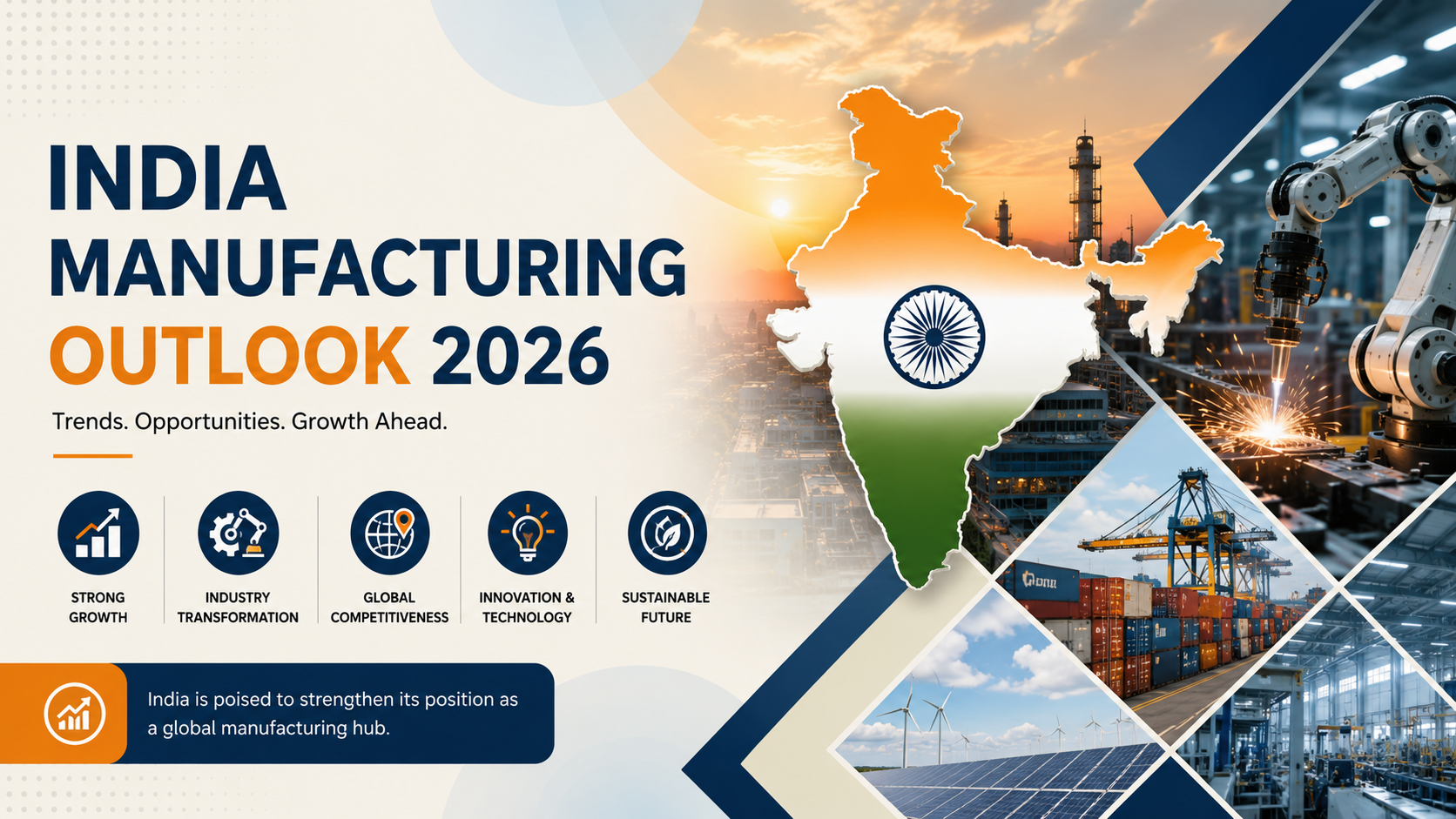
India’s manufacturing story in 2026 is one of expansion, investment, localisation, and growing strategic importance.
The sector continues to grow, but the outlook is becoming more nuanced. Manufacturers are benefiting from government incentives, electronics investment, semiconductor expansion, infrastructure spending, and supply-chain diversification. At the same time, softer demand, global uncertainty, cost pressure, and dependence on imported components remain important challenges.
📊 2026 Snapshot
Manufacturing PMI: Expansion continued in June 2026, although growth moderated compared with earlier months.
PLI investment: Cumulative investment under India’s Production Linked Incentive schemes exceeded ₹2.16 lakh crore across strategic sectors.
Critical import opportunity: India has identified around $51 billion of priority imports for potential domestic manufacturing.
Semiconductor push: India approved a major new phase of semiconductor investment in July 2026.
Together, these signals point toward a manufacturing sector that is increasingly focused on deeper domestic capability rather than only final assembly.
1. Manufacturing Is Still Expanding, But Momentum Has Moderated
India’s manufacturing sector remained in expansion territory during the first half of 2026.
However, June data showed slower growth in new orders and output compared with previous months.
The June manufacturing PMI remained above the 50-point level that separates expansion from contraction, but Reuters reported that factory growth had slowed to one of its weakest rates since mid-2022, excluding an exceptional March reading.
This does not necessarily signal contraction.
Instead, it suggests that manufacturers may need to navigate a more competitive demand environment during the remainder of 2026.
🏭 2. Localisation Is Becoming a Bigger Industrial Theme
One of the strongest manufacturing trends in 2026 is India’s renewed focus on reducing import dependence.
Government analysis has identified roughly $398 billion of imports with potential for domestic substitution, with around $51 billion across approximately 100 priority items targeted for closer attention.
The opportunity spans sectors such as electric vehicles, solar equipment, textiles, footwear, and other industrial categories.
For Indian suppliers, localisation can create opportunities far beyond the final product.
A new domestic manufacturing line may require:
Machining → Components → Tooling → Automation → Electrical Systems → Testing → Packaging → Maintenance
The bigger opportunity is therefore the supplier ecosystem created around localisation.
⚡ 3. Electronics and Semiconductors Are Becoming Major Growth Engines
Electronics manufacturing remains one of India’s most strategically important industrial sectors.
In July 2026, the government approved a new semiconductor initiative with an allocation of approximately ₹1.27 lakh crore, alongside a ₹62,500 crore mobile-phone manufacturing programme.
The Electronics Components Manufacturing Scheme also received an increased outlay of ₹40,000 crore in the 2026–27 Union Budget.
These investments could strengthen demand across:
Precision engineering
Electronics components
Automation
Cleanroom systems
Testing equipment
Industrial gases
Machine building
Packaging
Logistics
The semiconductor opportunity in particular is likely to create an ecosystem extending well beyond chip fabrication itself.
🤖 4. Automation Will Become More Important
As Indian manufacturers compete on productivity, quality, traceability, and delivery speed, automation will continue moving from optional investment to operational necessity.
Factories are increasingly exploring:
Industrial robotics
Machine vision
PLC and SCADA systems
Manufacturing dashboards
Industrial IoT
AI-assisted quality control
Predictive maintenance
The objective is shifting from simply automating individual machines to connecting production data across the factory.
This trend should create opportunities for automation integrators, machine builders, control-panel manufacturers, industrial software companies, and engineering service providers.
🔧 5. Supplier Capability Will Matter More Than Supplier Availability
India already has a large manufacturing supplier base.
The bigger challenge is identifying suppliers with the exact combination of capability, capacity, quality systems, certifications, location, and commercial fit required by buyers.
As supply chains become more sophisticated, buyers will increasingly evaluate suppliers on:
Technical capability
Quality consistency
Delivery reliability
Traceability
Digital responsiveness
Ability to scale
This could gradually shift industrial procurement from relationship-driven supplier discovery toward more structured, data-driven sourcing.
⚠️ Key Challenges for 2026
The outlook is positive, but several challenges remain.
Import Dependence
Many industries still rely heavily on imported machinery, electronics, raw materials, and specialised components.
Global Demand
Slower international demand can affect export-oriented manufacturers.
Cost Competitiveness
Domestic manufacturing must compete not only on availability but also on price, quality, and delivery speed.
Skills and Technology
Advanced manufacturing requires stronger capabilities in automation, electronics, precision engineering, software, and specialised production processes.
🔭 Outlook: From “Make in India” to “Build the Ecosystem in India”
The next phase of Indian manufacturing is likely to be defined by deeper localisation.
The focus is moving beyond assembling final products toward building complete domestic ecosystems around components, machinery, technology, materials, and suppliers.
For Indian manufacturers, this creates a significant opportunity.
The companies best positioned for the next phase will be those that combine:
Engineering capability + Quality + Technology + Supply reliability + Digital visibility
India’s manufacturing opportunity in 2026 is therefore not simply about producing more.
It is about building stronger industrial capabilities, developing competitive supplier networks, and creating manufacturing ecosystems that can serve both domestic and global markets.