
Introduction
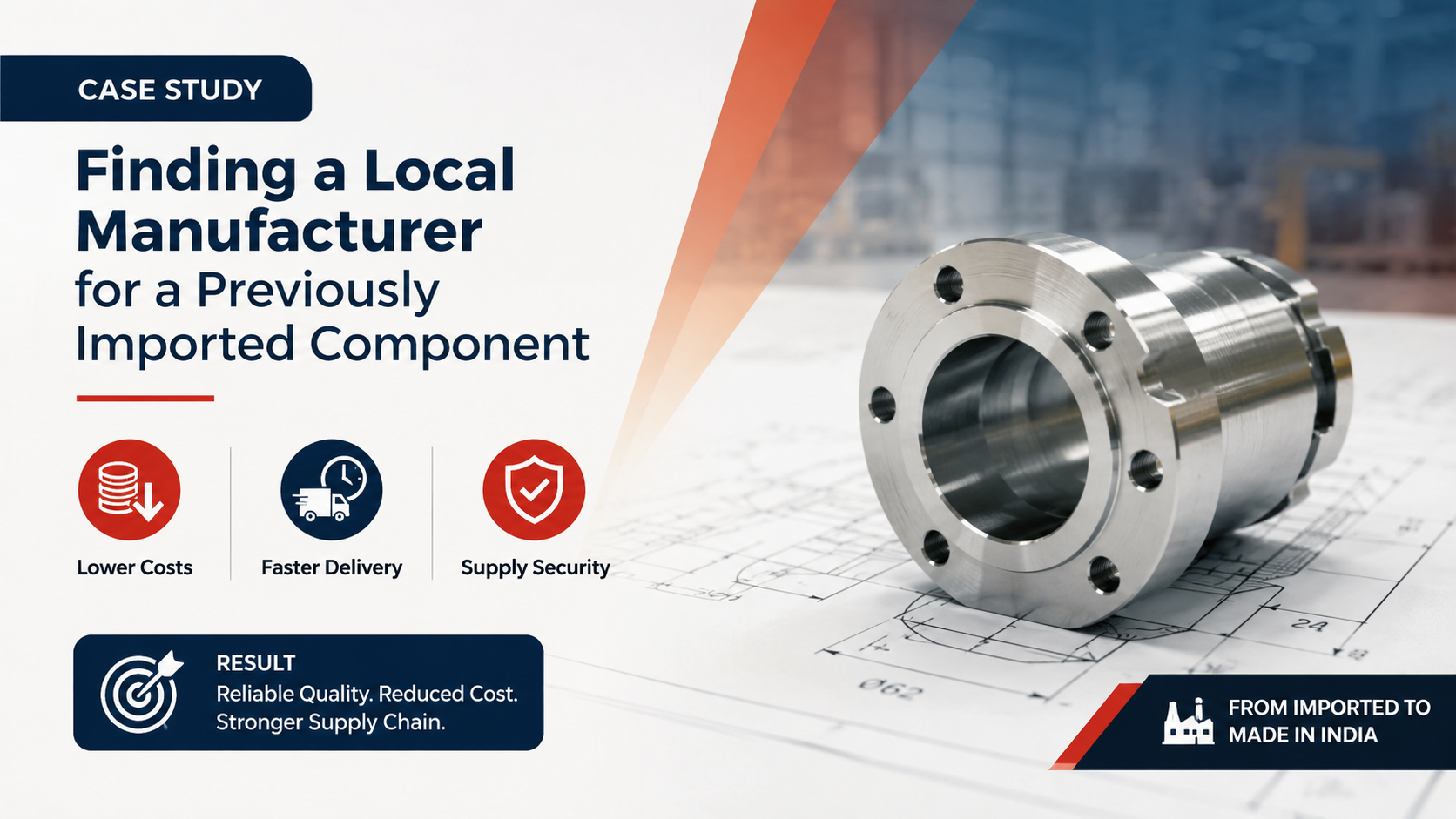
For years, a mid-sized Indian manufacturer depended on an imported precision component used inside one of its production systems.
The arrangement had worked reasonably well until longer lead times, fluctuating freight costs, and inconsistent availability started creating problems.
What initially looked like a simple sourcing issue quickly became a wider operational risk.
The Situation
The imported component itself was not highly complex, but it required:
Tight machining tolerances
Consistent material quality
Reliable dimensional accuracy
Repeatable batch production
Proper inspection records
The company had never seriously explored local sourcing because the imported supplier was already approved and changing vendors felt risky.
That changed when delivery cycles became unpredictable.
A component that once arrived within a manageable timeframe started taking significantly longer, while shipping and import-related costs continued to increase.
The procurement team decided to explore whether a domestic manufacturer could produce the same part reliably.
The Challenge
Finding a local manufacturer was not as simple as searching for “CNC machining companies.”
Hundreds of potential suppliers appeared relevant.
But only a smaller number had the actual capability required for the application.
The team needed to answer four important questions:
1. Can they manufacture the component accurately?
The supplier needed suitable CNC equipment, measurement capability, and experience working with similar tolerances.
2. Can they maintain consistency?
Producing one acceptable sample was not enough.
The supplier needed to demonstrate repeatability across production batches.
3. Can they meet the required volume?
The company needed confidence that the supplier could support regular demand without affecting delivery schedules.
4. Can they become a long-term partner?
Communication, documentation, responsiveness, and engineering support were also important.
🔍 The Supplier Evaluation Process
Instead of contacting dozens of companies, the procurement team created a structured shortlist.
Potential suppliers were evaluated across:
Technical Capability Machines, tolerances, materials, inspection systems
Relevant Experience Similar components and industries served
Quality Systems Inspection processes, documentation, certifications
Commercial Fit Pricing, minimum order quantity, payment terms
Delivery Capability Production capacity and realistic lead times
The most promising suppliers received technical drawings and specifications under confidentiality.
A small sample batch was then ordered from shortlisted companies.
🧪 Sample Before Scale
This became the most important step in the sourcing process.
The first samples were checked for:
Dimensional accuracy
Material specification
Surface finish
Assembly fit
Performance during operation
Minor corrections were made after the first trial.
Once the revised component successfully passed internal testing, the company moved to a controlled production batch before gradually increasing order volumes.
This reduced the risk of switching suppliers too quickly.
📦 The Outcome
The transition created several practical benefits.
Shorter Lead Times
Domestic sourcing removed long international shipping cycles.
Better Communication
Engineering questions and design changes could be resolved faster.
Lower Inventory Pressure
The company no longer needed to hold as much buffer stock to protect against import delays.
More Supply Flexibility
Smaller batches could be ordered when required.
Reduced Dependency
The business was no longer completely dependent on a single overseas source.
💡 The Bigger Lesson
Localization is not simply about replacing an imported component with the cheapest local alternative.
The real objective is finding a supplier that can match the required technical performance while improving overall supply-chain resilience.
The successful sourcing journey looked like this:
Requirement → Supplier Discovery → Capability Evaluation → Sampling → Validation → Controlled Production → Scale
For manufacturers exploring import substitution, the biggest challenge may not be whether capable suppliers exist locally.
It may be finding the right one and evaluating them properly.
A structured supplier discovery process can turn an import dependency into an opportunity to build a faster, more flexible, and more resilient domestic supply chain.