
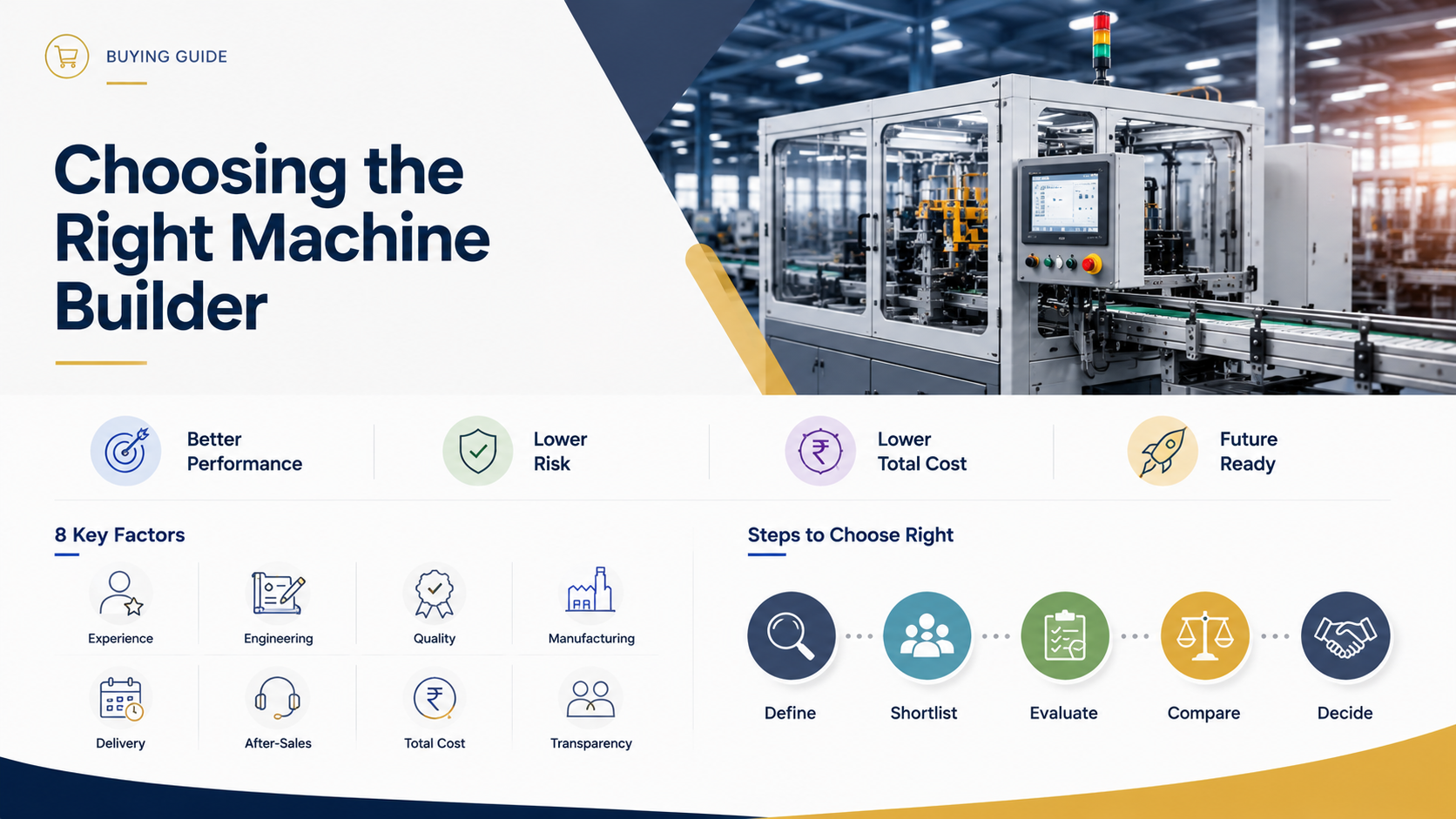
Introduction
Buying a custom machine is rarely a simple equipment purchase.
The machine may become part of your production line for years, influence product quality, affect cycle time, determine labor requirements, and directly impact your ability to scale.
That makes choosing the right machine builder a strategic decision.
A lower quotation may look attractive initially, but poor engineering, weak support, limited documentation, or unreliable automation can create much higher costs later.
Here is what buyers should evaluate before selecting a machine builder.
⚙️ 1. Start With Engineering Capability
The first question should not be:
“How much will the machine cost?”
It should be:
“Can this company engineer the right solution for our process?”
A capable machine builder should understand the complete application, including:
Process requirements | Cycle time | Product variation | Safety | Automation | Quality checks | Maintenance
Ask how they approach concept development.
Do they simply build from your specification, or can they challenge assumptions and suggest a better machine concept?
Strong machine builders behave like engineering partners, not just fabricators.
🏭 2. Check Relevant Industry Experience
Experience matters, but relevance matters more.
A company may have built hundreds of machines, yet still lack experience with your process or industry.
Look for projects involving similar:
Products
Materials
Production volumes
Automation levels
Environmental conditions
Quality requirements
For example, a food-processing machine may require very different material selection, hygiene standards, and cleaning considerations than an automotive assembly machine.
Ask for case studies, videos, drawings, references, or examples of comparable systems.
🤖 3. Evaluate Automation Expertise
Modern machinery often combines mechanical design with electrical, PLC, HMI, robotics, sensors, vision systems, servo drives, and industrial software.
Your machine builder should understand how these systems work together.
Ask questions such as:
Which PLC platforms do you support?
Can you integrate robots or machine vision?
Do you provide remote diagnostics?
Can production data connect with MES or ERP systems?
A mechanically strong machine with weak controls can still create major operational problems.
🧩 4. Understand the Level of Customization
Not every requirement needs a fully custom machine.
Some applications can use a standard platform with modifications, while others require complete engineering from scratch.
Clarify this early.
RequirementBest ApproachCommon processStandard machineMinor variationConfigured solutionUnique production needCustom machineFuture product expansionModular designA modular machine can be especially valuable when you expect future product variants, capacity increases, or additional automation.
📋 5. Review Documentation and Compliance
Documentation is often overlooked during supplier selection.
Before placing an order, confirm what will be delivered.
This may include:
🔹 Mechanical drawings 🔹 Electrical schematics 🔹 PLC and HMI backups 🔹 Operating manuals 🔹 Maintenance schedules 🔹 Spare-parts lists 🔹 Safety documentation 🔹 Compliance certificates
Good documentation reduces your long-term dependence on the original machine builder.
Also verify applicable safety and regulatory standards based on your industry and destination market.
🛠️ 6. Ask About Installation and After-Sales Support
A machine is not finished when it leaves the builder’s factory.
You may still need installation, commissioning, operator training, troubleshooting, spare parts, software changes, and future upgrades.
Ask:
Who handles installation?
How quickly can technical support respond?
Are critical spare parts locally available?
Can problems be diagnosed remotely?
For mission-critical machinery, after-sales capability can be just as important as the original engineering.
💰 7. Compare Total Value, Not Just Price
Suppose Machine Builder A quotes 15% less than Machine Builder B.
That does not automatically make A cheaper.
Consider:
Cycle time + Downtime + Energy + Maintenance + Scrap + Labor + Spare parts + Expected machine life
A slightly higher upfront investment can deliver significantly better economics over several years.
✅ Final Machine Builder Checklist
Before making your decision, confirm that the supplier demonstrates:
Strong engineering capability Relevant industry experience Reliable automation expertise Clear project management Proper documentation Safety and compliance understanding Responsive after-sales support Ability to support future upgrades
The right machine builder does more than deliver equipment.
They understand your production objective, engineer around real operational challenges, and build a system that continues creating value long after commissioning.