
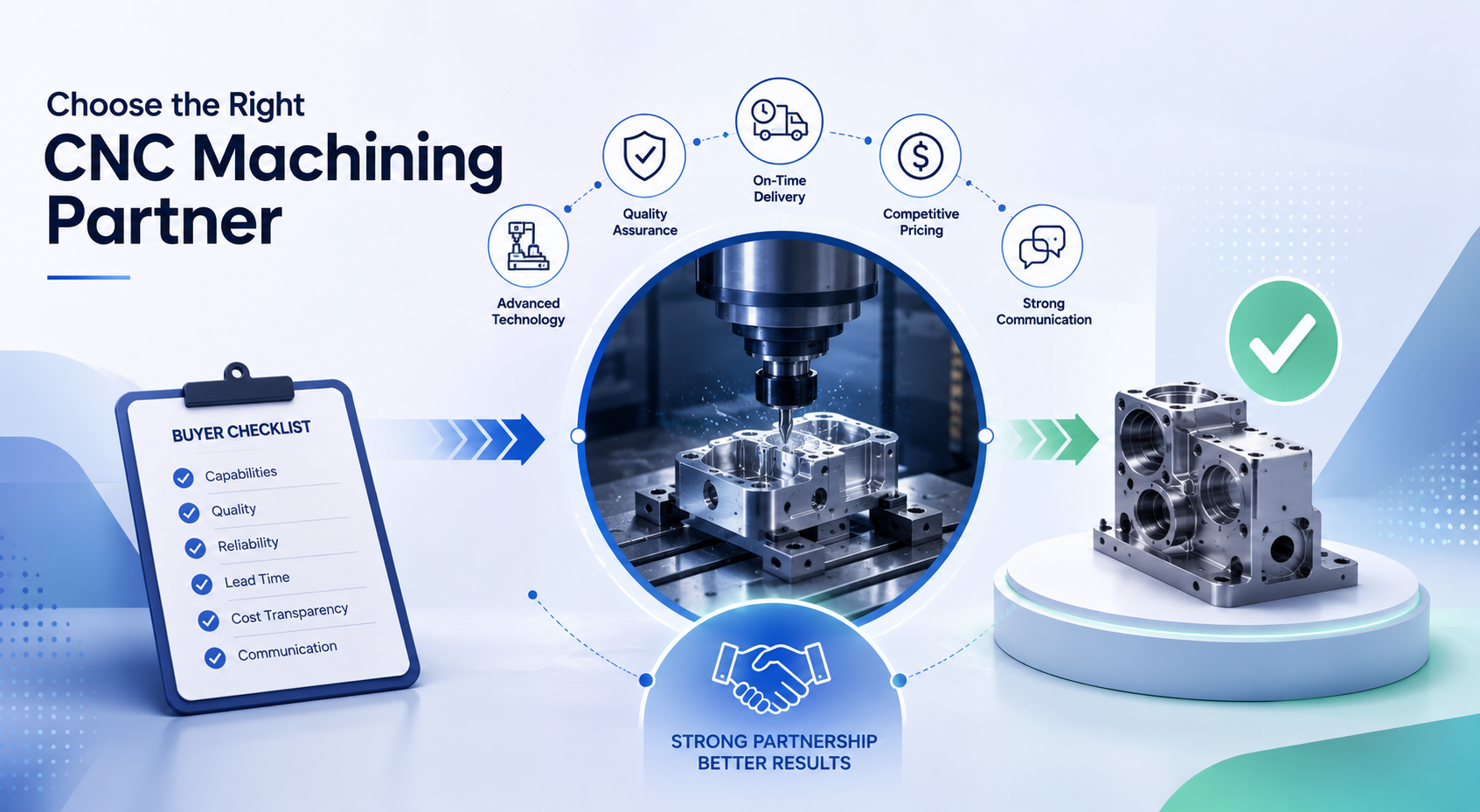
Introduction
Choosing a CNC machining partner isn’t simply about finding someone who can make your part.
The real question is:
Can they make it accurately, consistently, at the required volume, within your timeline, and without creating problems as you scale?
A supplier offering the lowest quote may not always offer the lowest total cost once rejected parts, delays, rework, logistics, and inconsistent quality enter the equation.
Here are 7 things to evaluate before choosing your CNC machining partner.
1. Start With the Actual Machining Capability
A company saying “We provide CNC machining” tells you very little.
Your requirement may need:
3-axis milling | 5-axis machining | CNC turning | Mill-turn | Tight-tolerance machining | Complex geometries
Ask what machines they operate, their maximum work envelope, achievable tolerances, and whether critical operations are performed in-house.
Buyer Tip: Send a representative drawing and ask how they would manufacture it. Their response can reveal far more than a capability brochure.
2. Check Their Experience With Your Materials
Machining aluminium is very different from machining titanium, hardened steel, engineering plastics, or exotic alloys.
Ask:
Which materials do you machine regularly?
Can you provide material traceability?
Do you source certified raw materials?
What finishing processes can you manage?
A supplier already familiar with your material is more likely to understand tooling, speeds, feeds, distortion risks, and finishing requirements.
3. Define Tolerances Before Asking for Price
This is where many sourcing conversations go wrong.
A drawing with ±0.1 mm requirements and one requiring ±0.01 mm may demand very different equipment, inspection, setup, and cost.
Modern CNC networks can offer tolerances around ±0.020 mm or tighter for certain processes, but tighter tolerances should be specified only where functionally necessary.
Quick Check
Before requesting a quotation, clearly identify:
Critical dimensions → Tolerances → Surface finish → Threads → Inspection requirements
This makes quotations much easier to compare accurately.
4. Look Beyond the Certificate on the Wall
ISO 9001 can indicate that a supplier operates a structured quality management system, while industries such as aerospace and medical manufacturing may require standards such as AS9100 or ISO 13485.
But certification alone isn’t enough.
Ask about:
CMM inspection • First Article Inspection • Dimensional reports • Material certificates • PPAP • Certificates of Conformance
These are examples of quality documentation commonly available in mature manufacturing environments.
Ask yourself: If a critical dimension fails tomorrow, can this supplier trace what happened and prevent it from happening again?
5. Prototype Capability ≠ Production Capability
A machine shop may produce five excellent prototypes but struggle with 5,000 repeat parts.
If your volumes could grow, investigate:
Current capacity → Repeatability → Production scheduling → Backup machines → Batch inspection → Scalability
Also ask what happens when demand suddenly doubles.
A good long-term partner should fit not only your current requirement, but your likely production journey from prototype to repeat manufacturing.
6. Compare Total Value, Not Just Unit Price
Imagine three quotations:
SupplierUnit PriceLead TimeQuality ConfidenceA$184 weeksHighB$147 weeksUnknownC$165 weeksHighIs Supplier B really cheapest?
Maybe. Maybe not.
Consider tooling, inspection, rejected parts, shipping, packaging, payment terms, rework risk, and communication overhead.
The best procurement decision is often based on total landed value and risk, not the lowest number in the quotation.
7. Test Communication Before Placing the Order
Communication problems during quotation often become bigger problems during production.
Notice whether the supplier:
✓ Asks intelligent technical questions ✓ Flags potential manufacturability issues ✓ Responds clearly and consistently ✓ Provides realistic lead times ✓ Suggests cost-saving alternatives
A strong machining partner shouldn’t simply manufacture your drawing.
They should help you manufacture it better.
Your 60-Second Supplier Checklist
Before selecting your CNC machining partner, ask:
☐ Can they achieve my required tolerances?
☐ Do they regularly machine my materials?
☐ Do they have the right machines and capacity?
☐ Can they provide the required inspection documentation?
☐ Do they hold relevant certifications?
☐ Can they scale from prototype to production?
☐ Are pricing and lead times transparent?
☐ Do they communicate like a long-term engineering partner?
Final Thought
The right CNC machining partner is not necessarily the biggest supplier, the nearest supplier, or the cheapest supplier.
It is the one whose capabilities, quality systems, capacity, experience, and reliability best match your specific requirement.
Don’t just compare quotations. Compare capability, risk, and fit.