
Introduction
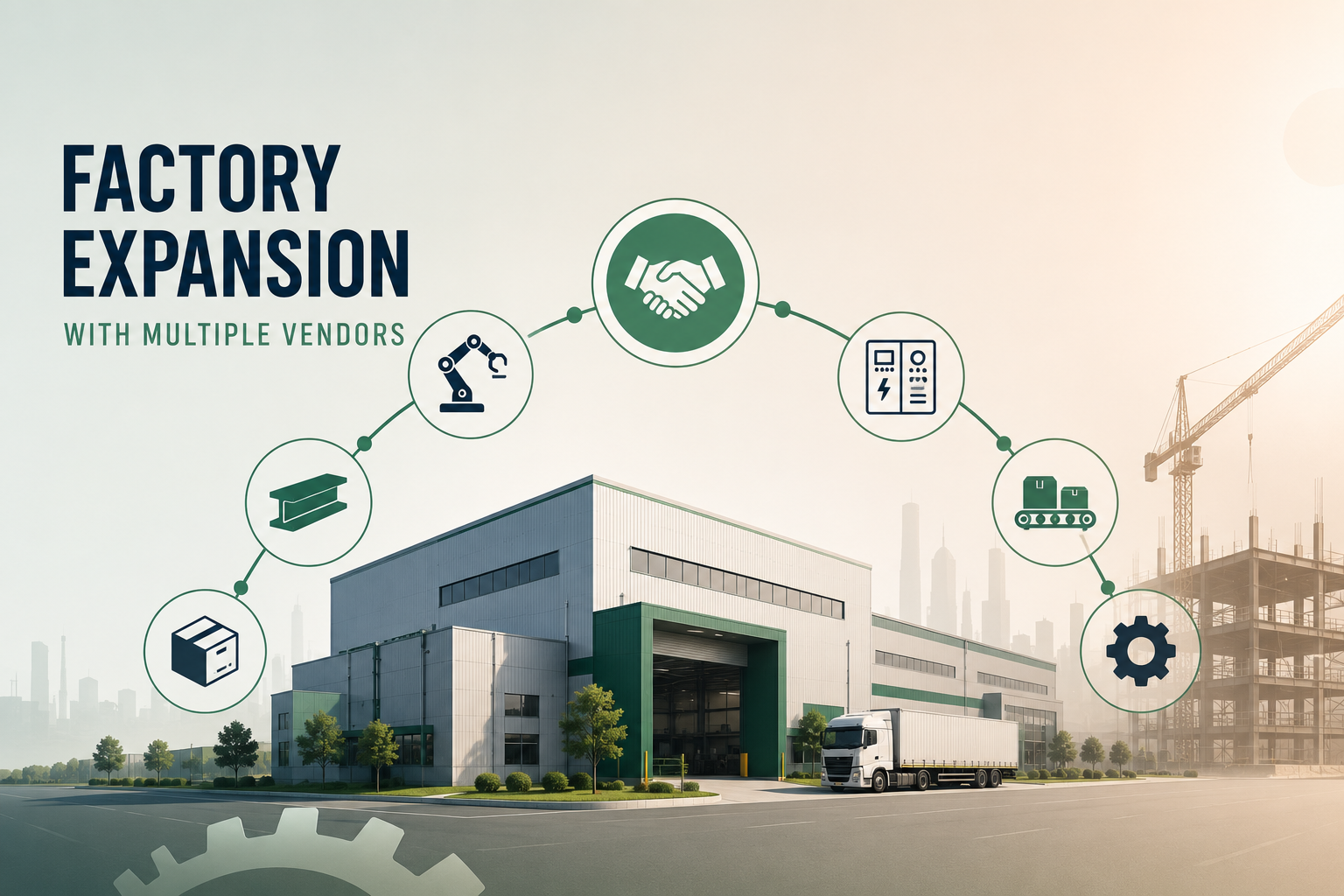
Factory expansion rarely means buying one machine from one supplier.
A major expansion can involve production machinery, automation systems, electrical panels, material handling equipment, fabricated structures, utilities, safety systems, and hundreds of smaller components — often sourced from different vendors.
For one growing manufacturer, this created a major procurement challenge:
How do you coordinate multiple specialized suppliers without allowing delays, mismatched specifications, or one late vendor to disrupt the entire expansion?
Here’s how a structured sourcing approach helped bring the project together.
🏭 The Challenge
The manufacturer was expanding an existing production facility to increase capacity and introduce a new manufacturing line.
The project required multiple sourcing packages:
Production Equipment Conveyors & Material Handling Electrical & Control Panels Industrial Automation Fabricated Structures Pumps & Utilities Safety Equipment
The problem wasn't finding a supplier.
It was finding the right combination of suppliers and ensuring they could work within the same project requirements.
The Procurement Risk
Imagine this sequence:
Fabrication delayed → Equipment installation delayed → Electrical work delayed → Commissioning delayed → Production start delayed
In an interconnected expansion project, one supplier can affect everyone downstream.
🔎 Step 1: Breaking One Large Project Into Sourcing Packages
Instead of treating the expansion as one enormous RFQ, procurement divided requirements into specialized packages.
Each package clearly defined:
Technical specifications
Quantities
Required certifications
Delivery milestones
Installation responsibilities
Interface requirements
This allowed suppliers to be evaluated based on their specific capabilities, rather than selecting one vendor simply because they could manage everything.
Sourcing Insight: The best supplier for automation may not be the best supplier for fabrication — specialization matters.
🤝 Step 2: Evaluating Vendors Beyond Price
Multiple quotations were collected, but price wasn't used as the only deciding factor.
Suppliers were compared across five dimensions:
FactorEvaluationTechnical FitCan they meet specifications?CapacityCan they deliver at the required scale?QualityDo they have adequate systems and certifications?DeliveryCan they meet project milestones?CommercialIs the total cost competitive?Some lower-priced quotations were rejected because delivery risk or technical gaps could create larger costs later.
The objective became:
Best Value = Capability + Quality + Delivery + Cost + Reliability
🔗 Step 3: Managing Supplier Dependencies
Selecting vendors was only half the job.
The next challenge was coordination.
For example, the conveyor supplier required dimensions from the equipment manufacturer.
The automation integrator needed electrical documentation.
The panel builder needed finalized I/O requirements.
Instead of managing each purchase order independently, the project mapped these dependencies.
Simple Dependency Flow
Machine Design
↓
Mechanical Interfaces
↓
Electrical & Automation
↓
Installation
↓
Integration & Commissioning
Suppliers could now see where their deliverables affected the broader project.
📊 Step 4: Creating One Source of Procurement Visibility
A centralized tracking structure was established covering:
RFQ → Supplier Selection → PO → Manufacturing → Inspection → Dispatch → Installation
Critical milestones were reviewed regularly.
Potential delays could therefore be identified before they became site-level problems.
This was especially important for long-lead equipment and custom-manufactured components.
📈 The Outcome
The structured multi-vendor approach helped the manufacturer:
✓ Source specialized vendors based on capability
✓ Compare suppliers beyond quotation price
✓ Improve visibility across procurement packages
✓ Identify supplier dependencies earlier
✓ Reduce last-minute sourcing decisions
✓ Coordinate deliveries with installation schedules
Most importantly, procurement became part of the project planning process, rather than simply a purchasing function.
💡 Key Lesson for Industrial Buyers
Factory expansion projects don't fail because companies cannot find suppliers.
They often struggle because dozens of suppliers, specifications, timelines, and dependencies must work together.
The winning approach is not necessarily:
“Find one supplier who can do everything.”
It is:
“Find the right supplier for each requirement — and manage them as one connected sourcing ecosystem.”
For complex industrial projects, better supplier discovery is only the beginning.
Supplier coordination, visibility, technical fit, and dependency management ultimately determine whether multiple vendors become a project risk — or a competitive advantage.