
Introduction
Buying an industrial control panel sounds straightforward.
Prepare specifications. Send RFQs. Compare quotations. Select a panel builder.
But when a manufacturer needed a new control panel for a production-line expansion, the procurement team quickly discovered something important:
A control panel isn't simply a product you purchase. It is an engineered system that must fit the machine, electrical infrastructure, automation architecture, safety requirements, and project timeline.
Here’s how the procurement journey unfolded.
🏭 The Requirement: More Than an Electrical Enclosure
The project involved expanding an automated production line with motors, sensors, conveyors, and process equipment.
The new control panel needed to integrate everything.
The initial requirement included:
PLC & HMI | VFDs | Motor Control | Safety Circuits | Power Distribution | Field I/O
At first, procurement considered sending a basic bill of quantities to several panel builders.
But engineering identified a problem.
Different suppliers could interpret the same requirement very differently.
Without a clear technical scope, comparing quotations would become difficult.
📋 Step 1: Building a Clear RFQ Package
Before approaching suppliers, procurement and engineering worked together to define the requirement.
The RFQ package included:
Electrical load details
I/O requirements
Preferred automation architecture
Approved component makes
Communication protocols
Enclosure specifications
Environmental conditions
Documentation requirements
Responsibilities also had to be clarified.
Would the supplier only build the panel?
Or would they also handle:
Electrical Design → PLC Programming → FAT → Installation → Commissioning?
This distinction significantly affected both price and supplier selection.
Procurement Lesson: Never compare control panel quotations until you're sure suppliers are quoting the same scope.
🔎 Step 2: Finding the Right Panel Builders
Several potential suppliers were shortlisted.
But instead of asking only:
“Can you build this panel?”
The evaluation went deeper.
Suppliers were assessed on:
Technical Capability | Similar Projects | Engineering Team | Component Experience | Testing Facilities | Delivery Capacity
One supplier offered the lowest quotation but had limited experience with the required automation platform.
Another was technically strong but depended heavily on outsourced engineering.
A third demonstrated relevant project experience and could handle design, manufacturing, programming, and commissioning internally.
The cheapest quotation was no longer automatically the best option.
⚖️ Step 3: Comparing Quotations Correctly
Quotation comparison revealed another challenge.
Supplier A included PLC programming.
Supplier B excluded field cabling.
Supplier C included FAT but excluded commissioning.
The commercial values couldn't be compared directly.
A normalized comparison was created:
ScopeSupplier ASupplier BSupplier CPanel Design✓✓✓Manufacturing✓✓✓PLC/HMI Software✓Extra✓FAT✓✓✓InstallationExtraExcluded✓CommissioningExtraExtra✓Once the scope was aligned, the actual commercial difference became much clearer.
🛠️ Step 4: Design Approval Before Manufacturing
After supplier selection, manufacturing did not begin immediately.
The supplier first submitted:
GA Drawings → Electrical Schematics → BOM → Panel Layout
Engineering reviewed component selection, spare capacity, terminal arrangements, cable entry, safety circuits, and maintainability.
Several changes were identified before fabrication.
Making these changes on drawings took days.
Making them after the panel reached the factory could have taken weeks.
Approve the engineering before approving the manufacturing.
🧪 Step 5: Factory Acceptance Testing
Before dispatch, the panel underwent Factory Acceptance Testing.
The team verified:
✓ Wiring and component installation
✓ PLC and HMI functionality
✓ Safety interlocks
✓ Alarm conditions
✓ Communication interfaces
✓ Documentation
Several minor issues were corrected at the supplier's facility.
This prevented troubleshooting from being pushed to the installation site, where every lost day could affect the production schedule.
🚀 The Outcome
The structured procurement process resulted in:
✓ Clearer supplier comparison
✓ Better alignment between procurement and engineering
✓ Fewer scope disputes
✓ Design issues identified before manufacturing
✓ Reduced commissioning risk
✓ Better documentation for future maintenance
Most importantly, supplier selection was based on total project capability, not simply panel cost.
💡 The Key Lesson
Control panel procurement sits at the intersection of purchasing and engineering.
A successful journey looks like:
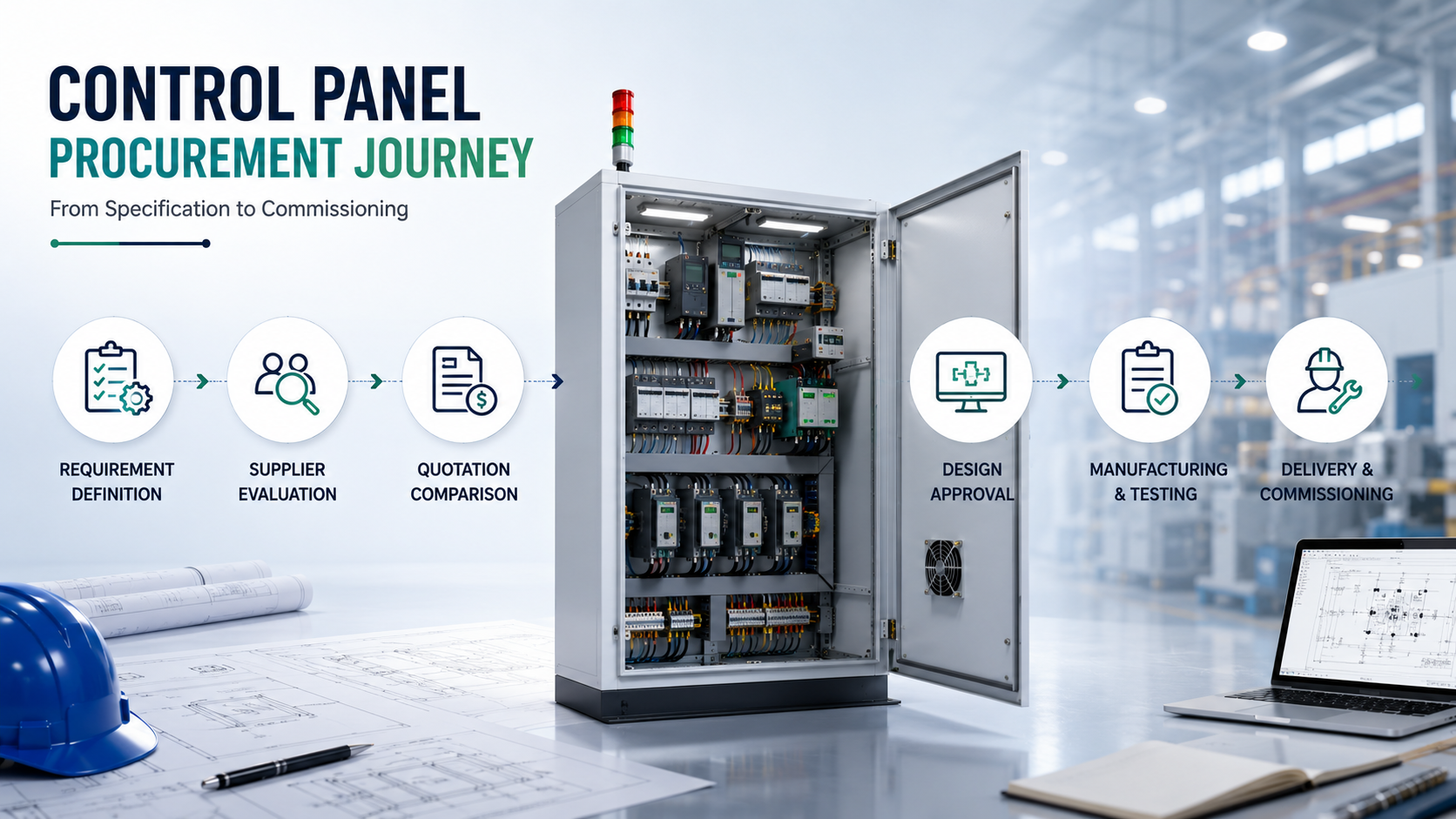
Define → Discover → Evaluate → Compare → Approve → Build → Test → Commission
Skipping any of these stages may save time initially but create much larger problems later.
The best control panel supplier isn't necessarily the company offering the lowest quotation.
It is the one capable of delivering an engineered system that works correctly, integrates smoothly, arrives on schedule, and keeps working long after commissioning.