
Introduction
For years, B2B procurement followed a familiar process.
A buyer identified a requirement, searched existing vendor lists, asked colleagues for recommendations, contacted multiple suppliers, exchanged emails, collected quotations, and manually compared options.
That model is changing.
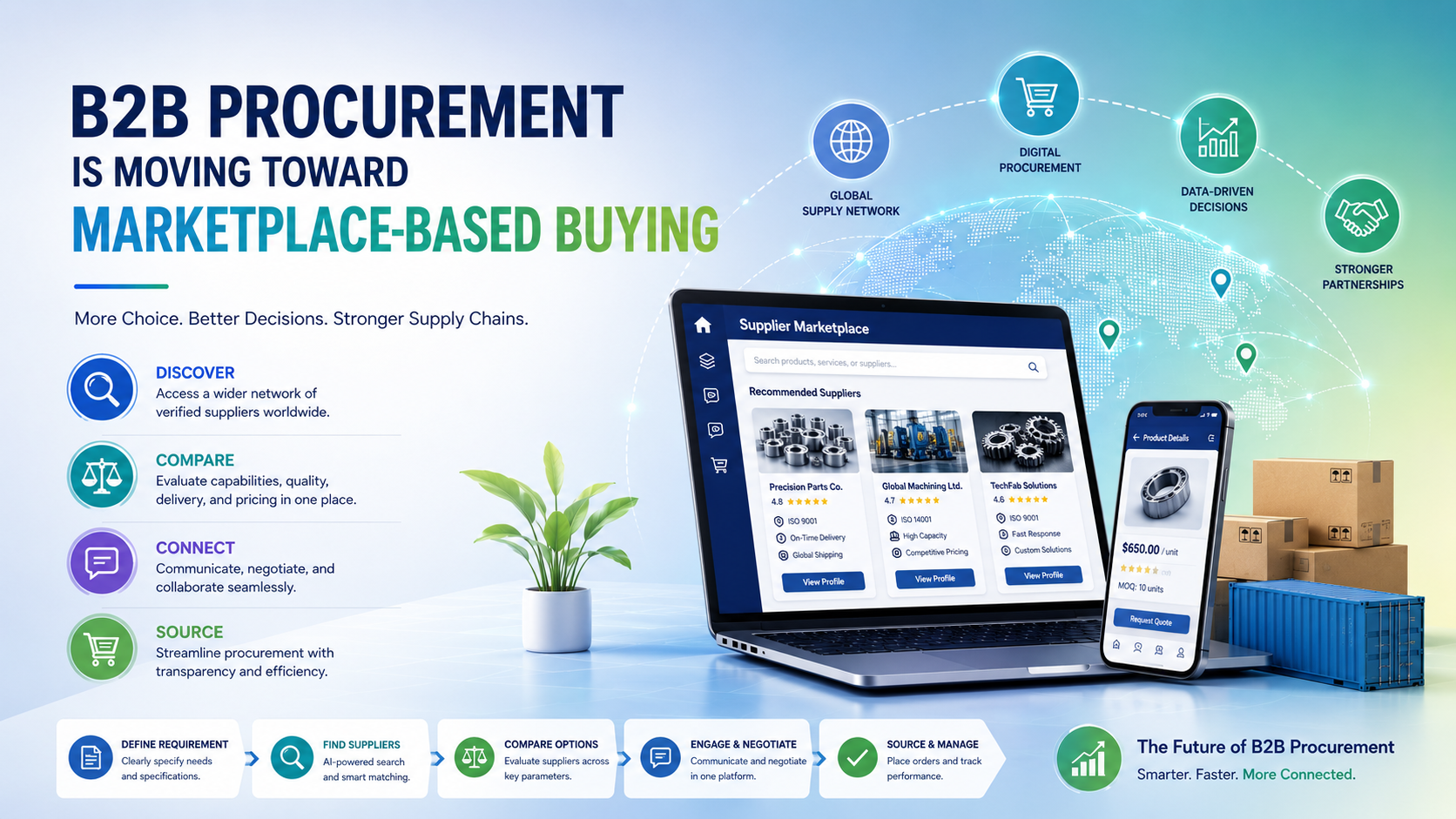
Across industries, digital marketplaces and procurement platforms are creating a different buying experience, bringing supplier discovery, comparison, communication, and purchasing workflows into more connected digital environments.
The shift raises an important question:
Could industrial procurement eventually become as digitally accessible as consumer buying, without losing the complexity B2B sourcing requires?
🔄 From Vendor Lists to Digital Supplier Networks
Traditional procurement often starts with suppliers a company already knows.
That creates efficiency, but it can also limit discovery.
A procurement team looking for a specialized manufacturer may need to search Google, browse directories, attend exhibitions, contact industry associations, or depend on referrals.
Marketplace-based sourcing changes the starting point.
Traditional Model
Requirement → Known Vendors → RFQs → Quotations → Selection
Marketplace Model
Requirement → Supplier Discovery → Compare Options → Engage → Source
Instead of limiting sourcing to an existing network, buyers can potentially access a much broader supplier ecosystem.
🔎 Supplier Discovery Is Becoming a Bigger Part of Procurement
Finding suppliers sounds simple until the requirement becomes specific.
Imagine a buyer needs:
A manufacturer capable of producing low-volume precision stainless-steel components with tight tolerances and specific quality certifications.
A keyword search may return hundreds of companies.
But how many actually match?
Modern B2B marketplaces are increasingly organizing supplier information around structured attributes such as:
Capabilities | Products | Materials | Certifications | Geography | Industries | Capacity
This can help buyers move from simply finding companies toward identifying suppliers that better match the actual requirement.
⚖️ Buyers Want Easier Comparison
Consumer marketplaces changed buying by making options easier to compare.
B2B procurement is moving in a similar direction, although industrial purchasing is considerably more complex.
Price is only one factor.
A sourcing decision may involve:
FactorBuyer QuestionCapabilityCan they manufacture it?QualityCan they meet specifications?CapacityCan they handle the volume?DeliveryCan they meet the timeline?CertificationDo they meet required standards?LocationDoes geography affect risk or logistics?PriceIs the total cost competitive?Digital marketplaces can bring more of this information into one sourcing environment.
The result isn't necessarily automatic purchasing.
It is better-informed purchasing.
🤖 AI Could Accelerate the Marketplace Shift
The next evolution may be driven by artificial intelligence.
Instead of buyers manually applying dozens of filters, AI-powered platforms could interpret sourcing requirements directly.
A buyer might simply say:
“Find sheet metal fabricators in India that work with stainless steel, support low-volume production, and have relevant quality certifications.”
The system could then analyze supplier data and identify potential matches.
This creates a new procurement journey:
Describe Requirement → AI Understands → Suppliers Matched → Compare → Engage
For complex industrial sourcing, this could significantly reduce the time spent navigating supplier databases.
🏭 What Does This Mean for Suppliers?
The marketplace shift changes supplier marketing too.
Traditionally, industrial suppliers relied heavily on:
Relationships + Sales Teams + Trade Shows + Distributors + Referrals
These channels will remain important.
But digital discoverability is becoming another competitive factor.
Suppliers increasingly need structured information about their:
✓ Manufacturing capabilities
✓ Products and services
✓ Equipment and capacity
✓ Certifications
✓ Industries served
✓ Geographic reach
A supplier with excellent capabilities but poor digital visibility may become harder for modern sourcing systems to discover.
🚀 The Bigger Shift: From Marketplace to Sourcing Ecosystem
The future of B2B marketplaces may extend far beyond online supplier listings.
Platforms could increasingly combine:
Discovery → Matching → RFQs → Comparison → Communication → Transactions → Supplier Performance
This would turn marketplaces from digital directories into broader procurement ecosystems.
For buyers, the value is not simply having more suppliers.
It is being able to identify the right suppliers faster and with better information.
For suppliers, the opportunity is equally significant: access to buyers beyond traditional networks and geographic boundaries.
The next generation of B2B procurement may not begin with “Who do we already know?”
It may begin with:
“Who is best equipped to fulfill this requirement?”
And that shift could fundamentally change how industrial buyers and suppliers find each other.